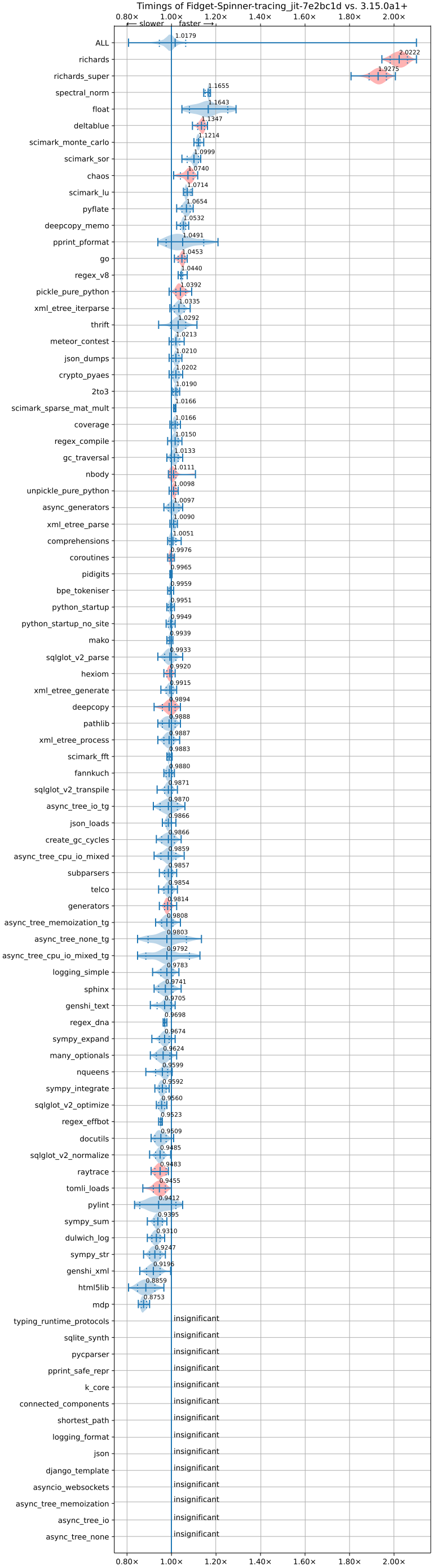
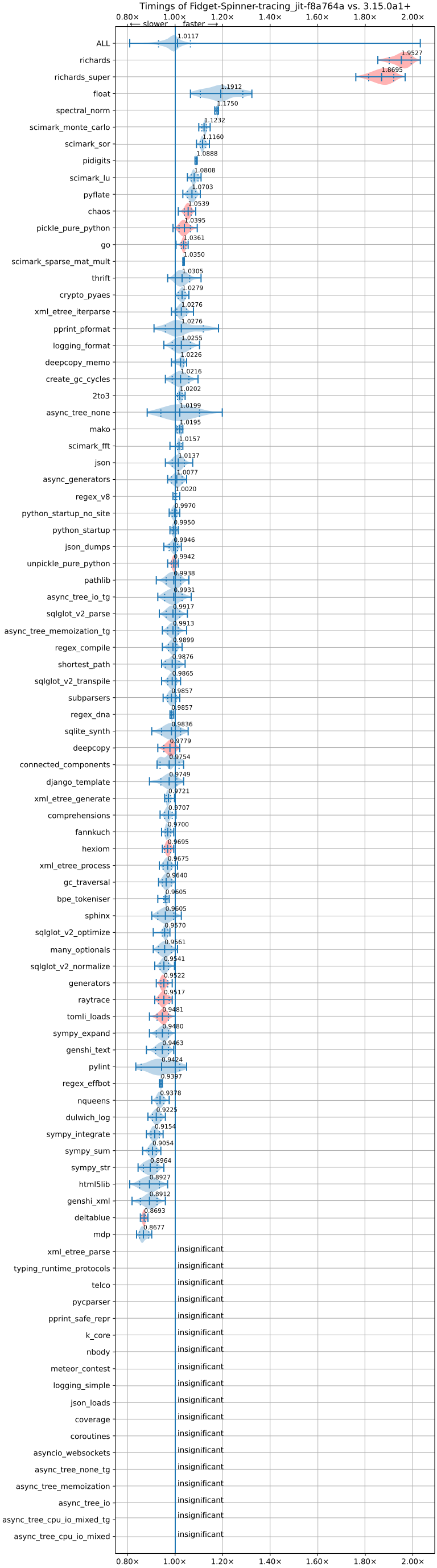
This PR changes the current JIT model from trace projection to trace recording. Benchmarking: better pyperformance (about 1.7% overall) geomean versus current https://raw.githubusercontent.com/facebookexperimental/free-threading-benchmarking/refs/heads/main/results/bm-20251108-3.15.0a1%2B-7e2bc1d-JIT/bm-20251108-vultr-x86_64-Fidget%252dSpinner-tracing_jit-3.15.0a1%2B-7e2bc1d-vs-base.svg, 100% faster Richards on the most improved benchmark versus the current JIT. Slowdown of about 10-15% on the worst benchmark versus the current JIT. **Note: the fastest version isn't the one merged, as it relies on fixing bugs in the specializing interpreter, which is left to another PR**. The speedup in the merged version is about 1.1%. https://raw.githubusercontent.com/facebookexperimental/free-threading-benchmarking/refs/heads/main/results/bm-20251112-3.15.0a1%2B-f8a764a-JIT/bm-20251112-vultr-x86_64-Fidget%252dSpinner-tracing_jit-3.15.0a1%2B-f8a764a-vs-base.svg

Stats: 50% more uops executed, 30% more traces entered the last time we ran them. It also suggests our trace lengths for a real trace recording JIT are too short, as a lot of trace too long aborts https://github.com/facebookexperimental/free-threading-benchmarking/blob/main/results/bm-20251023-3.15.0a1%2B-eb73378-CLANG%2CJIT/bm-20251023-vultr-x86_64-Fidget%252dSpinner-tracing_jit-3.15.0a1%2B-eb73378-pystats-vs-base.md .

This new JIT frontend is already able to record/execute significantly more instructions than the previous JIT frontend. In this PR, we are now able to record through custom dunders, simple object creation, generators, etc. None of these were done by the old JIT frontend. Some custom dunders uops were discovered to be broken as part of this work gh-140277

The optimizer stack space check is disabled, as it's no longer valid to deal with underflow.

Pros:
* Ignoring the generated tracer code as it's automatically created, this is only additional 1k lines of code. The maintenance burden is handled by the DSL and code generator.
* `optimizer.c` is now significantly simpler, as we don't have to do strange things to recover the bytecode from a trace.
* The new JIT frontend is able to handle a lot more control-flow than the old one.
* Tracing is very low overhead. We use the tail calling interpreter/computed goto interpreter to switch between tracing mode and non-tracing mode. I call this mechanism dual dispatch, as we have two dispatch tables dispatching to each other. Specialization is still enabled while tracing.
* Better handling of polymorphism. We leverage the specializing interpreter for this.

Cons:
* (For now) requires tail calling interpreter or computed gotos. This means no Windows JIT for now :(. Not to fret, tail calling is coming soon to Windows though https://github.com/python/cpython/pull/139962

Design:
* After each instruction, the `record_previous_inst` function/label is executed. This does as the name suggests.
* The tracing interpreter lowers bytecode to uops directly so that it can obtain "fresh" values at the point of lowering.
* The tracing version behaves nearly identical to the normal interpreter, in fact it even has specialization! This allows it to run without much of a slowdown when tracing. The actual cost of tracing is only a function call and writes to memory.
* The tracing interpreter uses the specializing interpreter's deopt to naturally form the side exit chains. This allows it to side exit chain effectively, without repeating much code. We force a re-specializing when tracing a deopt.
* The tracing interpreter can even handle goto errors/exceptions, but I chose to disable them for now as it's not tested.
* Because we do not share interpreter dispatch, there is should be no significant slowdown to the original specializing interpreter on tailcall and computed got with JIT disabled. With JIT enabled, there might be a slowdown in the form of the JIT trying to trace.
* Things that could have dynamic instruction pointer effects are guarded on. The guard deopts to a new instruction --- `_DYNAMIC_EXIT`.
Add PyUnstable_ThreadState_SetStackProtection() and
PyUnstable_ThreadState_ResetStackProtection() functions
to set the stack base address and stack size of a Python
thread state.

Co-authored-by: Petr Viktorin <encukou@gmail.com>
Allow the --enable-pystats build option to be used with free-threading.  The
stats are now stored on a per-interpreter basis, rather than process global.
For free-threaded builds, the stats structure is allocated per-thread and
then periodically merged into the per-interpreter stats structure (on thread
exit or when the reporting function is called). Most of the pystats related
code has be moved into the file Python/pystats.c.
In the free threaded build, the `_PyObject_LookupSpecial()` call can lead to
reference count contention on the returned function object becuase it
doesn't use stackrefs. Refactor some of the callers to use
`_PyObject_MaybeCallSpecialNoArgs`, which uses stackrefs internally.

This fixes the scaling bottleneck in the "lookup_special" microbenchmark
in `ftscalingbench.py`. However, the are still some uses of
`_PyObject_LookupSpecial()` that need to be addressed in future PRs.
The PyThreadState field gains a reference count field to avoid
issues with PyThreadState being a dangling pointer to freed memory.
The refcount starts with a value of two: one reference is owned by the
interpreter's linked list of thread states and one reference is owned by
the OS thread. The reference count is decremented when the thread state
is removed from the interpreter's linked list and before the OS thread
calls `PyThread_hang_thread()`. The thread that decrements it to zero
frees the `PyThreadState` memory.

The `holds_gil` field is moved out of the `_status` bit field, to avoid
a data race where on thread calls `PyThreadState_Clear()`, modifying the
`_status` bit field while the OS thread reads `holds_gil` when
attempting to acquire the GIL.

The `PyThreadState.state` field now has `_Py_THREAD_SHUTTING_DOWN` as a
possible value. This corresponds to the `_PyThreadState_MustExit()`
check. This avoids race conditions in the free threading build when
checking `_PyThreadState_MustExit()`.
* Implement C recursion protection with limit pointers for Linux, MacOS and Windows

* Remove calls to PyOS_CheckStack

* Add stack protection to parser

* Make tests more robust to low stacks

* Improve error messages for stack overflow
Revert "GH-91079: Implement C stack limits using addresses, not counters. (GH-130007)" for now

Unfortunatlely, the change broke some buildbots.

This reverts commit 2498c22fa0.
* Implement C recursion protection with limit pointers

* Remove calls to PyOS_CheckStack

* Add stack protection to parser

* Make tests more robust to low stacks

* Improve error messages for stack overflow
Each thread specializes a thread-local copy of the bytecode, created on the first RESUME, in free-threaded builds. All copies of the bytecode for a code object are stored in the co_tlbc array on the code object. Threads reserve a globally unique index identifying its copy of the bytecode in all co_tlbc arrays at thread creation and release the index at thread destruction. The first entry in every co_tlbc array always points to the "main" copy of the bytecode that is stored at the end of the code object. This ensures that no bytecode is copied for programs that do not use threads.

Thread-local bytecode can be disabled at runtime by providing either -X tlbc=0 or PYTHON_TLBC=0. Disabling thread-local bytecode also disables specialization.

Concurrent modifications to the bytecode made by the specializing interpreter and instrumentation use atomics, with specialization taking care not to overwrite an instruction that was instrumented concurrently.
* Remove `@suppress_immortalization` decorator
* Make suppression flag per-thread instead of per-interpreter
* Suppress immortalization in `eval()` to avoid refleaks in three tests
  (test_datetime.test_roundtrip, test_logging.test_config8_ok, and
   test_random.test_after_fork).
* frozenset() is constant, but not a singleton. When run multiple times,
  the test could fail due to constant interning.
Currently, we only use per-thread reference counting for heap type objects and
the naming reflects that. We will extend it to a few additional types in an
upcoming change to avoid scaling bottlenecks when creating nested functions.

Rename some of the files and functions in preparation for this change.
The free-threaded build partially stores heap type reference counts in
distributed manner in per-thread arrays. This avoids reference count
contention when creating or destroying instances.

Co-authored-by: Ken Jin <kenjin@python.org>
This combines and updates our freelist handling to use a consistent
implementation. Objects in the freelist are linked together using the
first word of memory block.

If configured with freelists disabled, these operations are essentially
no-ops.
This keeps track of the per-thread total reference count operations in
PyThreadState in the free-threaded builds. The count is merged into the
interpreter's total when the thread exits.
This adds `_PyMem_FreeDelayed()` and supporting functions. The
`_PyMem_FreeDelayed()` function frees memory with the same allocator as
`PyMem_Free()`, but after some delay to ensure that concurrent lock-free
readers have finished.
This adds a safe memory reclamation scheme based on FreeBSD's "GUS" and
quiescent state based reclamation (QSBR). The API provides a mechanism
for callers to detect when it is safe to free memory that may be
concurrently accessed by readers.
The GC keeps track of the number of allocations (less deallocations)
since the last GC. This buffers the count in thread-local state and uses
atomic operations to modify the per-interpreter count. The thread-local
buffering avoids contention on shared state.

A consequence is that the GC scheduling is not as precise, so
"test_sneaky_frame_object" is skipped because it requires that the GC be
run exactly after allocating a frame object.
For the most part, these changes make is substantially easier to backport subinterpreter-related code to 3.12, especially the related modules (e.g. _xxsubinterpreters). The main motivation is to support releasing a PyPI package with the 3.13 capabilities compiled for 3.12.

A lot of the changes here involve either hiding details behind macros/functions or splitting up some files.
Biased reference counting maintains two refcount fields in each object:
`ob_ref_local` and `ob_ref_shared`. The true refcount is the sum of these two
fields. In some cases, when refcounting operations are split across threads,
the ob_ref_shared field can be negative (although the total refcount must be
at least zero). In this case, the thread that decremented the refcount
requests that the owning thread give up ownership and merge the refcount
fields.
* gh-112532: Use separate mimalloc heaps for GC objects

In `--disable-gil` builds, we now use four separate heaps in
anticipation of using mimalloc to find GC objects when the GIL is
disabled. To support this, we also make a few changes to mimalloc:

* `mi_heap_t` and `mi_tld_t` initialization is split from allocation.
  This allows us to have a `mi_tld_t` per-`PyThreadState`, which is
  important to keep interpreter isolation, since the same OS thread may
  run in multiple interpreters (using different PyThreadStates.)

* Heap abandoning (mi_heap_collect_ex) can now be called from a
  different thread than the one that created the heap. This is necessary
  because we may clear and delete the containing PyThreadStates from a
  different thread during finalization and after fork().

* Use enum instead of defines and guard mimalloc includes.

* The enum typedef will be convenient for future PRs that use the type.
* Guarding the mimalloc includes allows us to unconditionally include
  pycore_mimalloc.h from other header files that rely on things like
  `struct _mimalloc_thread_state`.

* Only define _mimalloc_thread_state in Py_GIL_DISABLED builds
Every PyThreadState instance is now actually a _PyThreadStateImpl.
It is safe to cast from `PyThreadState*` to `_PyThreadStateImpl*` and back.
The _PyThreadStateImpl will contain fields that we do not want to expose
in the public C API.