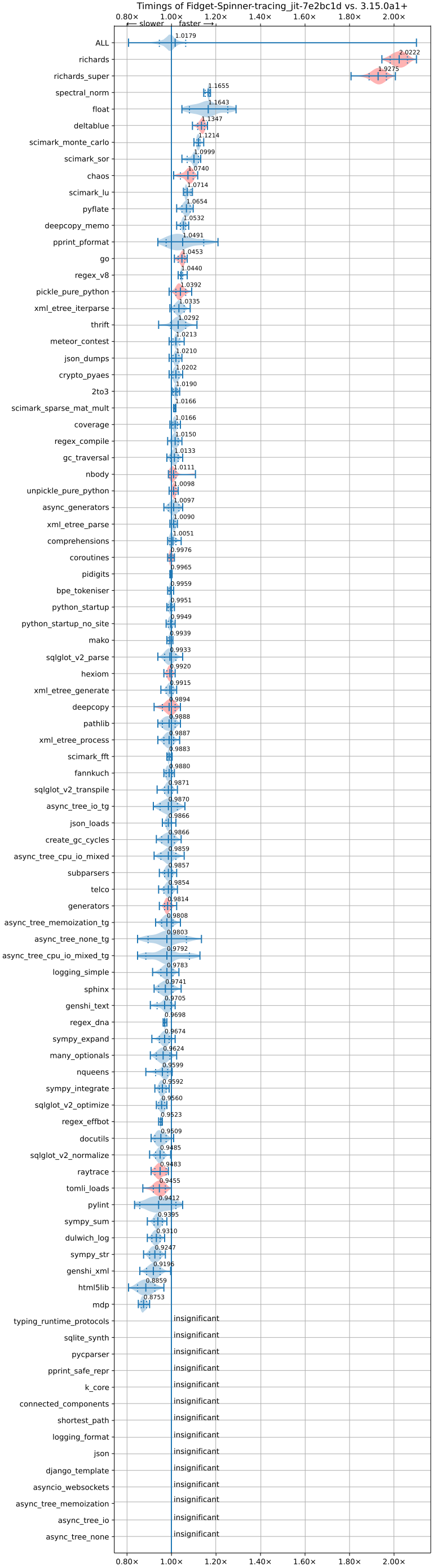
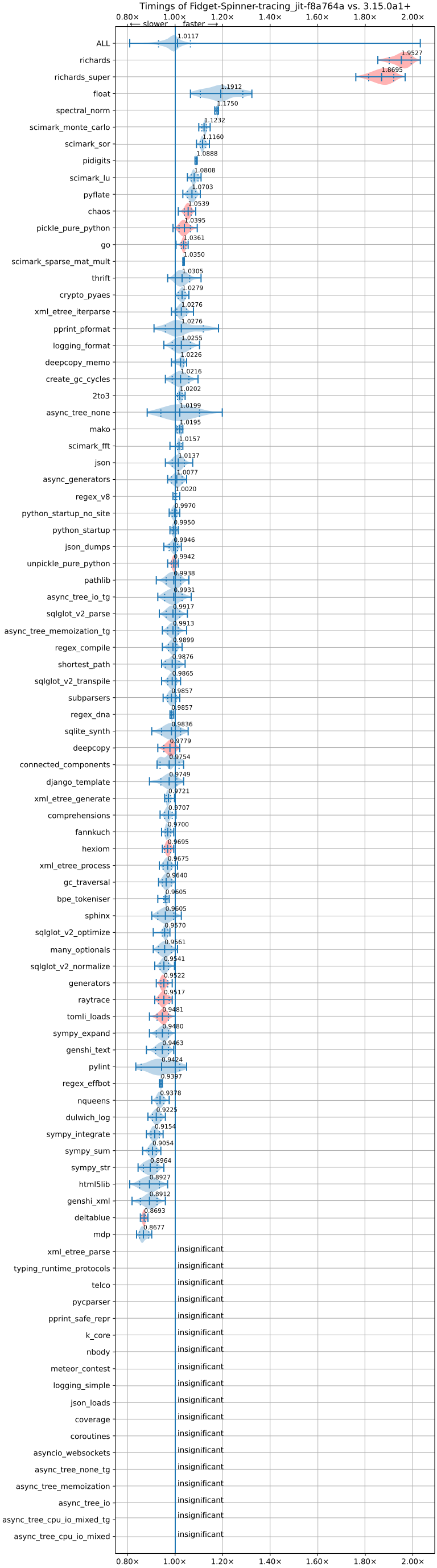
This PR changes the current JIT model from trace projection to trace recording. Benchmarking: better pyperformance (about 1.7% overall) geomean versus current https://raw.githubusercontent.com/facebookexperimental/free-threading-benchmarking/refs/heads/main/results/bm-20251108-3.15.0a1%2B-7e2bc1d-JIT/bm-20251108-vultr-x86_64-Fidget%252dSpinner-tracing_jit-3.15.0a1%2B-7e2bc1d-vs-base.svg, 100% faster Richards on the most improved benchmark versus the current JIT. Slowdown of about 10-15% on the worst benchmark versus the current JIT. **Note: the fastest version isn't the one merged, as it relies on fixing bugs in the specializing interpreter, which is left to another PR**. The speedup in the merged version is about 1.1%. https://raw.githubusercontent.com/facebookexperimental/free-threading-benchmarking/refs/heads/main/results/bm-20251112-3.15.0a1%2B-f8a764a-JIT/bm-20251112-vultr-x86_64-Fidget%252dSpinner-tracing_jit-3.15.0a1%2B-f8a764a-vs-base.svg

Stats: 50% more uops executed, 30% more traces entered the last time we ran them. It also suggests our trace lengths for a real trace recording JIT are too short, as a lot of trace too long aborts https://github.com/facebookexperimental/free-threading-benchmarking/blob/main/results/bm-20251023-3.15.0a1%2B-eb73378-CLANG%2CJIT/bm-20251023-vultr-x86_64-Fidget%252dSpinner-tracing_jit-3.15.0a1%2B-eb73378-pystats-vs-base.md .

This new JIT frontend is already able to record/execute significantly more instructions than the previous JIT frontend. In this PR, we are now able to record through custom dunders, simple object creation, generators, etc. None of these were done by the old JIT frontend. Some custom dunders uops were discovered to be broken as part of this work gh-140277

The optimizer stack space check is disabled, as it's no longer valid to deal with underflow.

Pros:
* Ignoring the generated tracer code as it's automatically created, this is only additional 1k lines of code. The maintenance burden is handled by the DSL and code generator.
* `optimizer.c` is now significantly simpler, as we don't have to do strange things to recover the bytecode from a trace.
* The new JIT frontend is able to handle a lot more control-flow than the old one.
* Tracing is very low overhead. We use the tail calling interpreter/computed goto interpreter to switch between tracing mode and non-tracing mode. I call this mechanism dual dispatch, as we have two dispatch tables dispatching to each other. Specialization is still enabled while tracing.
* Better handling of polymorphism. We leverage the specializing interpreter for this.

Cons:
* (For now) requires tail calling interpreter or computed gotos. This means no Windows JIT for now :(. Not to fret, tail calling is coming soon to Windows though https://github.com/python/cpython/pull/139962

Design:
* After each instruction, the `record_previous_inst` function/label is executed. This does as the name suggests.
* The tracing interpreter lowers bytecode to uops directly so that it can obtain "fresh" values at the point of lowering.
* The tracing version behaves nearly identical to the normal interpreter, in fact it even has specialization! This allows it to run without much of a slowdown when tracing. The actual cost of tracing is only a function call and writes to memory.
* The tracing interpreter uses the specializing interpreter's deopt to naturally form the side exit chains. This allows it to side exit chain effectively, without repeating much code. We force a re-specializing when tracing a deopt.
* The tracing interpreter can even handle goto errors/exceptions, but I chose to disable them for now as it's not tested.
* Because we do not share interpreter dispatch, there is should be no significant slowdown to the original specializing interpreter on tailcall and computed got with JIT disabled. With JIT enabled, there might be a slowdown in the form of the JIT trying to trace.
* Things that could have dynamic instruction pointer effects are guarded on. The guard deopts to a new instruction --- `_DYNAMIC_EXIT`.
The problem we're fixing here is that we were using PyDict_Size() on "defaults",
which it is actually a tuple.  We're also adding some explicit type checks.

This is a follow-up to gh-133221/gh-133528.
This reverts commit 3c73cf5 (gh-133497), which itself reverted
the original commit d270bb5 (gh-133221).

We reverted the original change due to failing android tests.
The checks in _PyCode_CheckNoInternalState() were too strict,
so we've relaxed them.
"Stateless" code is a function or code object which does not rely on external state or internal state.
It may rely on arguments and builtins, but not globals or a closure. I've left a comment in
pycore_code.h that provides more detail.

We also add _PyFunction_VerifyStateless(). The new functions will be used in several later changes
that facilitate "sharing" functions and code objects between interpreters.
Methods (functions defined in class scope) are likely to be cleaned
up by the GC anyway.

Add a new code flag, `CO_METHOD`, that is set for functions defined
in a class scope. Use that when deciding to defer functions.
Objects may be temporarily "resurrected" in destructors when calling
finalizers or watcher callbacks. We previously undid the resurrection
by decrementing the reference count using `Py_SET_REFCNT`. This was not
thread-safe because other threads might be accessing the object
(modifying its reference count) if it was exposed by the finalizer,
watcher callback, or temporarily accessed by a racy dictionary or list
access.

This adds internal-only thread-safe functions for temporary object
resurrection during destructors.
Enable specialization of LOAD_GLOBAL in free-threaded builds.

Thread-safety of specialization in free-threaded builds is provided by the following:

A critical section is held on both the globals and builtins objects during specialization. This ensures we get an atomic view of both builtins and globals during specialization.
Generation of new keys versions is made atomic in free-threaded builds.
Existing helpers are used to atomically modify the opcode.
Thread-safety of specialized instructions in free-threaded builds is provided by the following:

Relaxed atomics are used when loading and storing dict keys versions. This avoids potential data races as the dict keys versions are read without holding the dictionary's per-object lock in version guards.
Dicts keys objects are passed from keys version guards to the downstream uops. This ensures that we are loading from the correct offset in the keys object. Once a unicode key has been stored in a keys object for a combined dictionary in free-threaded builds, the offset that it is stored in will never be reused for a different key. Once the version guard passes, we know that we are reading from the correct offset.
The dictionary read fast-path is used to read values from the dictionary once we know the correct offset.
This replaces `_PyEval_BuiltinsFromGlobals` with
`_PyDict_LoadBuiltinsFromGlobals`, which returns a new reference
instead of a borrowed reference. Internally, the new function uses
per-thread reference counting when possible to avoid contention on the
refcount fields on the builtins module.
Use per-thread refcounting for the reference from function objects to
their corresponding code object. This can be a source of contention when
frequently creating nested functions. Deferred refcounting alone isn't a
great fit here because these references are on the heap and may be
modified by other libraries.
Stop the world when invalidating function versions

The tier1 interpreter specializes `CALL` instructions based on the values
of certain function attributes (e.g. `__code__`, `__defaults__`). The tier1
interpreter uses function versions to verify that the attributes of a function
during execution of a specialization match those seen during specialization.
A function's version is initialized in `MAKE_FUNCTION` and is invalidated when
any of the critical function attributes are changed. The tier1 interpreter stores
the function version in the inline cache during specialization. A guard is used by
the specialized instruction to verify that the version of the function on the operand
stack matches the cached version (and therefore has all of the expected attributes).
It is assumed that once the guard passes, all attributes will remain unchanged
while executing the rest of the specialized instruction.

Stopping the world when invalidating function versions ensures that all critical
function attributes will remain unchanged after the function version guard passes
in free-threaded builds. It's important to note that this is only true if the remainder
of the specialized instruction does not enter and exit a stop-the-world point.

We will stop the world the first time any of the following function attributes
are mutated:

- defaults
- vectorcall
- kwdefaults
- closure
- code

This should happen rarely and only happens once per function, so the performance
impact on majority of code should be minimal.

Additionally, refactor the API for manipulating function versions to more clearly
match the stated semantics.
Changes to the function version cache:

- In addition to the function object, also store the code object,
  and allow the latter to be retrieved even if the function has been evicted.
- Stop assigning new function versions after a critical attribute (e.g. `__code__`)
  has been modified; the version is permanently reset to zero in this case.
- Changes to `__annotations__` are no longer considered critical. (This fixes gh-109998.)

Changes to the Tier 2 optimization machinery:

- If we cannot map a function version to a function, but it is still mapped to a code object,
  we continue projecting the trace.
  The operand of the `_PUSH_FRAME` and `_POP_FRAME` opcodes can be either NULL,
  a function object, or a code object with the lowest bit set.

This allows us to trace through code that calls an ephemeral function,
i.e., a function that may not be alive when we are constructing the executor,
e.g. a generator expression or certain nested functions.
We will lose globals removal inside such functions,
but we can still do other peephole operations
(and even possibly [call inlining](https://github.com/python/cpython/pull/116290),
if we decide to do it), which only need the code object.
As before, if we cannot retrieve the code object from the cache, we stop projecting.
Somehow we ended up with two separate counter variables tracking "the next function version".
Most likely this was a historical accident where an old branch was updated incorrectly.
This PR merges the two counters into a single one: `interp->func_state.next_version`.
Replace most of calls of _PyErr_WriteUnraisableMsg() and some
calls of PyErr_WriteUnraisable(NULL) with PyErr_FormatUnraisable().

Co-authored-by: Victor Stinner <vstinner@python.org>
Move the following private functions and structures to
pycore_modsupport.h internal C API:

* _PyArg_BadArgument()
* _PyArg_CheckPositional()
* _PyArg_NoKeywords()
* _PyArg_NoPositional()
* _PyArg_ParseStack()
* _PyArg_ParseStackAndKeywords()
* _PyArg_Parser structure
* _PyArg_UnpackKeywords()
* _PyArg_UnpackKeywordsWithVararg()
* _PyArg_UnpackStack()
* _Py_ANY_VARARGS()

Changes:

* Python/getargs.h now includes pycore_modsupport.h to export
  functions.
* clinic.py now adds pycore_modsupport.h when one of these functions
  is used.
* Add pycore_modsupport.h includes when a C extension uses one of
  these functions.
* Define Py_BUILD_CORE_MODULE in C extensions which now include
  directly or indirectly (via code generated by Argument Clinic)
  pycore_modsupport.h:

  * _csv
  * _curses_panel
  * _dbm
  * _gdbm
  * _multiprocessing.posixshmem
  * _sqlite.row
  * _statistics
  * grp
  * resource
  * syslog

* _testcapi: bad_get() no longer uses METH_FASTCALL calling
  convention but METH_VARARGS. Replace _PyArg_UnpackStack() with
  PyArg_ParseTuple().
* _testcapi: add PYTESTCAPI_NEED_INTERNAL_API macro which is defined
  by _testcapi sub-modules which need the internal C API
  (pycore_modsupport.h): exceptions.c, float.c, vectorcall.c,
  watchers.c.
* Remove Include/cpython/modsupport.h header file.
  Include/modsupport.h no longer includes the removed header file.
* Fix mypy clinic.py
This finishes the work begun in gh-107760. When, while projecting a superblock, we encounter a call to a short, simple function, the superblock will now enter the function using `_PUSH_FRAME`, continue through it, and leave it using `_POP_FRAME`, and then continue through the original code. Multiple frame pushes and pops are even possible. It is also possible to stop appending to the superblock in the middle of a called function, when running out of space or encountering an unsupported bytecode.