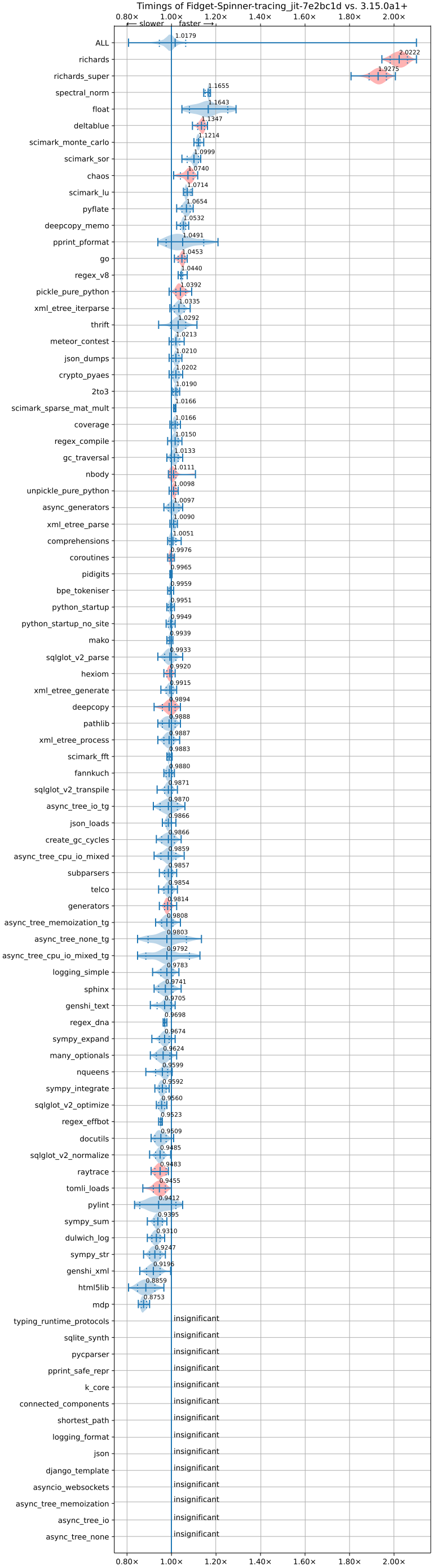
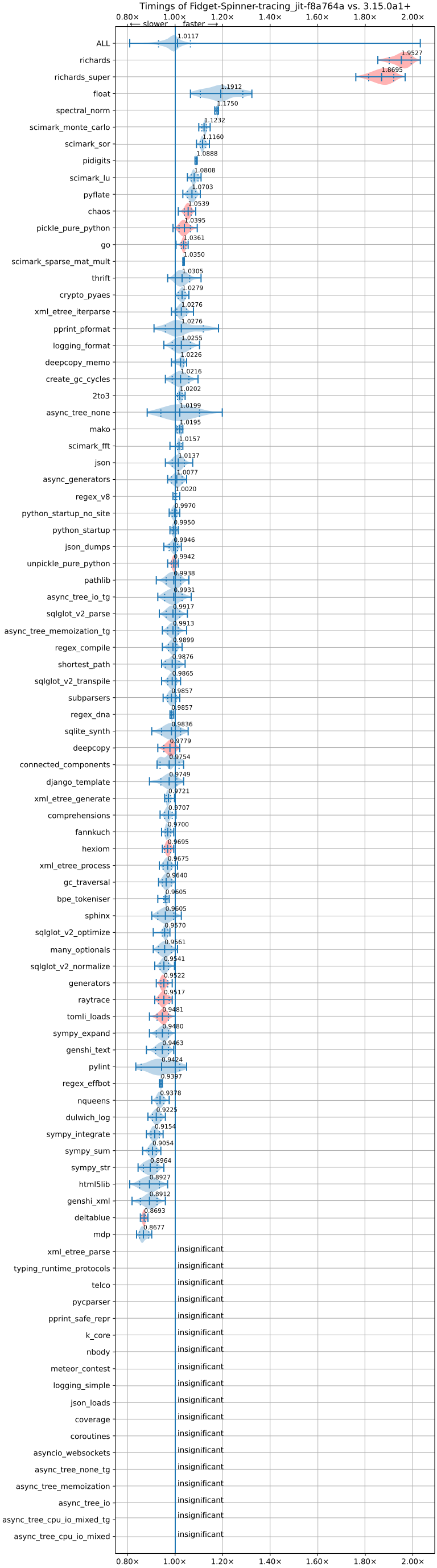
This PR changes the current JIT model from trace projection to trace recording. Benchmarking: better pyperformance (about 1.7% overall) geomean versus current https://raw.githubusercontent.com/facebookexperimental/free-threading-benchmarking/refs/heads/main/results/bm-20251108-3.15.0a1%2B-7e2bc1d-JIT/bm-20251108-vultr-x86_64-Fidget%252dSpinner-tracing_jit-3.15.0a1%2B-7e2bc1d-vs-base.svg, 100% faster Richards on the most improved benchmark versus the current JIT. Slowdown of about 10-15% on the worst benchmark versus the current JIT. **Note: the fastest version isn't the one merged, as it relies on fixing bugs in the specializing interpreter, which is left to another PR**. The speedup in the merged version is about 1.1%. https://raw.githubusercontent.com/facebookexperimental/free-threading-benchmarking/refs/heads/main/results/bm-20251112-3.15.0a1%2B-f8a764a-JIT/bm-20251112-vultr-x86_64-Fidget%252dSpinner-tracing_jit-3.15.0a1%2B-f8a764a-vs-base.svg

Stats: 50% more uops executed, 30% more traces entered the last time we ran them. It also suggests our trace lengths for a real trace recording JIT are too short, as a lot of trace too long aborts https://github.com/facebookexperimental/free-threading-benchmarking/blob/main/results/bm-20251023-3.15.0a1%2B-eb73378-CLANG%2CJIT/bm-20251023-vultr-x86_64-Fidget%252dSpinner-tracing_jit-3.15.0a1%2B-eb73378-pystats-vs-base.md .

This new JIT frontend is already able to record/execute significantly more instructions than the previous JIT frontend. In this PR, we are now able to record through custom dunders, simple object creation, generators, etc. None of these were done by the old JIT frontend. Some custom dunders uops were discovered to be broken as part of this work gh-140277

The optimizer stack space check is disabled, as it's no longer valid to deal with underflow.

Pros:
* Ignoring the generated tracer code as it's automatically created, this is only additional 1k lines of code. The maintenance burden is handled by the DSL and code generator.
* `optimizer.c` is now significantly simpler, as we don't have to do strange things to recover the bytecode from a trace.
* The new JIT frontend is able to handle a lot more control-flow than the old one.
* Tracing is very low overhead. We use the tail calling interpreter/computed goto interpreter to switch between tracing mode and non-tracing mode. I call this mechanism dual dispatch, as we have two dispatch tables dispatching to each other. Specialization is still enabled while tracing.
* Better handling of polymorphism. We leverage the specializing interpreter for this.

Cons:
* (For now) requires tail calling interpreter or computed gotos. This means no Windows JIT for now :(. Not to fret, tail calling is coming soon to Windows though https://github.com/python/cpython/pull/139962

Design:
* After each instruction, the `record_previous_inst` function/label is executed. This does as the name suggests.
* The tracing interpreter lowers bytecode to uops directly so that it can obtain "fresh" values at the point of lowering.
* The tracing version behaves nearly identical to the normal interpreter, in fact it even has specialization! This allows it to run without much of a slowdown when tracing. The actual cost of tracing is only a function call and writes to memory.
* The tracing interpreter uses the specializing interpreter's deopt to naturally form the side exit chains. This allows it to side exit chain effectively, without repeating much code. We force a re-specializing when tracing a deopt.
* The tracing interpreter can even handle goto errors/exceptions, but I chose to disable them for now as it's not tested.
* Because we do not share interpreter dispatch, there is should be no significant slowdown to the original specializing interpreter on tailcall and computed got with JIT disabled. With JIT enabled, there might be a slowdown in the form of the JIT trying to trace.
* Things that could have dynamic instruction pointer effects are guarded on. The guard deopts to a new instruction --- `_DYNAMIC_EXIT`.
With https://github.com/llvm/llvm-project/pull/150201 being merged, there is
now a better way to generate the Emscripten trampoline, instead of including
hand-generated binary WASM content. Requires Emscripten 4.0.12.
A runtime check is needed to support cross-compiling.

Remove the _Py_NORMALIZE_CENTURY macro.
Remove _pydatetime.py's _can_support_c99.

Co-authored-by: Serhiy Storchaka <storchaka@gmail.com>
This partially reverts #137047, keeping the tests for GC collectability of the
original class that dataclass adds `__slots__` to.
The reference leaks solved there are instead solved by having the `__dict__` &
`__weakref__` descriptors not tied to (and referencing) their class.

Instead, they're shared between all classes that need them (within
an interpreter).
The `__objclass__` ol the descriptors is set to `object`, since these
descriptors work with *any* object. (The appropriate checks were already
made in the get/set code, so the `__objclass__` check was redundant.)

The repr of these descriptors (and any others whose `__objclass__` is `object`)
now doesn't mention the objclass.

This change required adjustment of introspection code that checks
`__objclass__` to determine an object's “own” (i.e. not inherited) `__dict__`.
Third-party code that does similar introspection of the internals will also
need adjusting.


Co-authored-by: Jelle Zijlstra <jelle.zijlstra@gmail.com>
_testclinic.c mocks out PY_VERSION_HEX to 3.8 before including
_testclinic_depr.c.h to avoid the errors the preprocessor would
otherwise throw due to the deprecation feature it is testing.

Also partially revert 74e2acddf6:
this restores Modules/_testclinic.c to match the same file in the 3.14
branch.
Make the pwd module functions getpwuid(), getpwnam(), and getpwall() thread-safe. These changes apply to scenarios where the GIL is disabled or in subinterpreter use cases.
Make grp module methods getgrgid() and getgrnam() thread-safe when the GIL is disabled and getgrgid_r()/getgrnam_r() C APIs are not available.
---------

Co-authored-by: Kumar Aditya <kumaraditya@python.org>
Switches over to a _Py_thread_local in place of autoTssKey, and also fixes a few other checks regarding PyGILState_Ensure after finalization.

Note that this doesn't fix concurrent use of PyGILState_Ensure with Py_Finalize; I'm pretty sure zapthreads doesn't work at all, and that needs to be fixed seperately.
* Add _zstd module for https://peps.python.org/pep-0784/

This commit introduces the `_zstd` module, with bindings to libzstd from
the pyzstd project. It also includes the unix build system configuration.
Windows build system support will be integrated independently as it
depends on integration with cpython-source-deps.

* Add _zstd to modules

* Fix path for compression.zstd module

* Ignore _zstd module like _io

* Expand module state macros to improve code quality

Also removes module state references from the classes in the _zstd
module and instead uses PyType_GetModuleState()

* Remove backticks suggested in review

Co-authored-by: Stan Ulbrych <89152624+StanFromIreland@users.noreply.github.com>

* Use critical sections to lock object state

This should avoid races and deadlocks.

* Remove compress/decompress and mark module as not reliant on the GIL

The `compress`/`decompress` functions will be moved to Python code for simplicity.
C implementations can always be re-added in the future.

Also, mark _zstd as not requiring the GIL.

* Lift critical section to avoid clang warning

* Respond to comments by picnixz

* Call out pyzstd explicitly in license description

Co-authored-by: Adam Turner <9087854+AA-Turner@users.noreply.github.com>

* Use a much more robust implementation...

... for `get_zstd_state_from_type`

Co-authored-by: Bénédikt Tran <10796600+picnixz@users.noreply.github.com>

* Use PyList_GetItemRef for thread safety purposes

* Use a macro for the minimum supported version

* remove const from primivite types

* Use PyMem_New in another spot

* Simplify error handling in _get_frame_size

* Another simplification of error handling in get_frame_info

* Rename _module_state to mod_state

* Rewrite comment explaining the context of the code

* Add link to pyzstd

* Add TODO about refactoring dict training code

* Use PyModule_AddObjectRef over PyModule_AddObject

PyModule_AddObject is soft-deprecated, so we should use PyModule_AddObjectRef

* Check result of OutputBufferGrow

* Simplify return logic in `add_constant_to_type`

Co-authored-by: Bénédikt Tran <10796600+picnixz@users.noreply.github.com>

* Ignore return value of _zstd_clear()

Co-authored-by: Bénédikt Tran <10796600+picnixz@users.noreply.github.com>

* Remove redundant comments

* Remove __reduce__ from ZstdDict

We should instead document that to pickle a dictionary a user should use
the `.dict_content` attribute.

* Use PyUnicode_FromFormat instead of a buffer

* Don't use C constants/types in error messages

* Make error messages easier to understand for Python users

* Lower minimum required version 1.4.0

* Use casts and make slot function signatures correct

* Be consistent with CPython on const usage

* Make else clauses in line with PEP 7

* Fix over-indented blocks in argument clinic

* Add critical section around ZSTD_DCtx_setParameter

* Add a TODO about refactoring critical sections

* Use Py_UNREACHABLE

* Move bytes operations out of Py_BEGIN_ALLOW_THREADS

* Add TODO about ensuring a lock is held

* Remove asserts that may not be correct

* Add TODO to make ZstdDict and others GC objects

* Make objects GC tracked

* Remove unused include

* Fix some memory issues

* Fix refleaks on module and in ZstdDict

* Update configure to check for ZDICT_finalizeDictionary

* Properly check version in configure

* exit(1) if check fails

* Use AC_RUN_IFELSE

* Use a define() to re-use version check

* Actually properly set _zstd module status based on version

---------

Co-authored-by: Stan Ulbrych <89152624+StanFromIreland@users.noreply.github.com>
Co-authored-by: Adam Turner <9087854+AA-Turner@users.noreply.github.com>
Co-authored-by: Bénédikt Tran <10796600+picnixz@users.noreply.github.com>
A new extension module, `_hmac`, now exposes the HACL* HMAC (formally verified) implementation.

The HACL* implementation is used as a fallback implementation when the OpenSSL implementation of HMAC
is not available or disabled. For now, only named hash algorithms are recognized and SIMD support provided
by HACL* for the BLAKE2 hash functions is not yet used.
Avoid a data race in free-threaded builds due to mutating global arrays at
runtime.  Instead, compute the constants with an external Python script and
then define them as static global constant arrays.  These constants are
used by `long_from_non_binary_base()`.
Use an atomic operation when setting
`_PyRuntime.signals.unhandled_keyboard_interrupt`. We now only clear the
variable at the start of `_PyRun_Main`, which is the same function where
we check it.

This avoids race conditions where previously another thread might call
`run_eval_code_obj()` and erroneously clear the unhandled keyboard
interrupt.
This exposes `_Py_TryIncref` as `PyUnstable_TryIncref()` and the helper
function `_PyObject_SetMaybeWeakref` as `PyUnstable_EnableTryIncRef`.

These are helpers for dealing with unowned references in a safe way,
particularly in the free threading build.

Co-authored-by: Petr Viktorin <encukou@gmail.com>
- Add `git describe` output to headers generated by `make_ssl_data.py`

  This info is more important than the date when the file was generated.
  It does mean that the tool now requires a Git checkout of OpenSSL,
  not for example a release tarball.

- Regenerate the older file to add the info.
  To the other older file, add a note about manual edits.

- Add notes on how to add a new OpenSSL version

- Add 3.4 error messages and multissl tests
Move creation of a tuple for var-positional parameter out of
_PyArg_UnpackKeywordsWithVararg().
Merge _PyArg_UnpackKeywordsWithVararg() with _PyArg_UnpackKeywords().
Add a new parameter in _PyArg_UnpackKeywords().

The "parameters" and "converters" attributes of ParseArgsCodeGen no
longer contain the var-positional parameter. It is now available as the
"varpos" attribute. Optimize code generation for var-positional
parameter and reuse the same generating code for functions with and without
keyword parameters.

Add special converters for var-positional parameter. "tuple" represents it as
a Python tuple and "array" represents it as a continuous array of PyObject*.
"object" is a temporary alias of "tuple".
The primary objective here is to allow some later changes to be cleaner. Mostly this involves renaming things and moving a few things around.

* CrossInterpreterData -> XIData
* crossinterpdatafunc -> xidatafunc
* split out pycore_crossinterp_data_registry.h
* add _PyXIData_lookup_t
* Remove references to `Modules/_blake2`.

* Remove `Modules/_blake2` entry from CODEOWNERS

The folder does not exist anymore.

* Remove `Modules/_blake2` entry from `Tools/c-analyzer/TODO`
Users want to know when the current context switches to a different
context object.  Right now this happens when and only when a context
is entered or exited, so the enter and exit events are synonymous with
"switched".  However, if the changes proposed for gh-99633 are
implemented, the current context will also switch for reasons other
than context enter or exit.  Since users actually care about context
switches and not enter or exit, replace the enter and exit events with
a single switched event.

The former exit event was emitted just before exiting the context.
The new switched event is emitted after the context is exited to match
the semantics users expect of an event with a past-tense name.  If
users need the ability to clean up before the switch takes effect,
another event type can be added in the future.  It is not added here
because YAGNI.

I skipped 0 in the enum as a matter of practice.  Skipping 0 makes it
easier to troubleshoot when code forgets to set zeroed memory, and it
aligns with best practices for other tools (e.g.,
https://protobuf.dev/programming-guides/dos-donts/#unspecified-enum).

Co-authored-by: Richard Hansen <rhansen@rhansen.org>
Co-authored-by: Victor Stinner <vstinner@python.org>
Users want to know when the current context switches to a different
context object.  Right now this happens when and only when a context
is entered or exited, so the enter and exit events are synonymous with
"switched".  However, if the changes proposed for gh-99633 are
implemented, the current context will also switch for reasons other
than context enter or exit.  Since users actually care about context
switches and not enter or exit, replace the enter and exit events with
a single switched event.

The former exit event was emitted just before exiting the context.
The new switched event is emitted after the context is exited to match
the semantics users expect of an event with a past-tense name.  If
users need the ability to clean up before the switch takes effect,
another event type can be added in the future.  It is not added here
because YAGNI.

I skipped 0 in the enum as a matter of practice.  Skipping 0 makes it
easier to troubleshoot when code forgets to set zeroed memory, and it
aligns with best practices for other tools (e.g.,
https://protobuf.dev/programming-guides/dos-donts/#unspecified-enum).