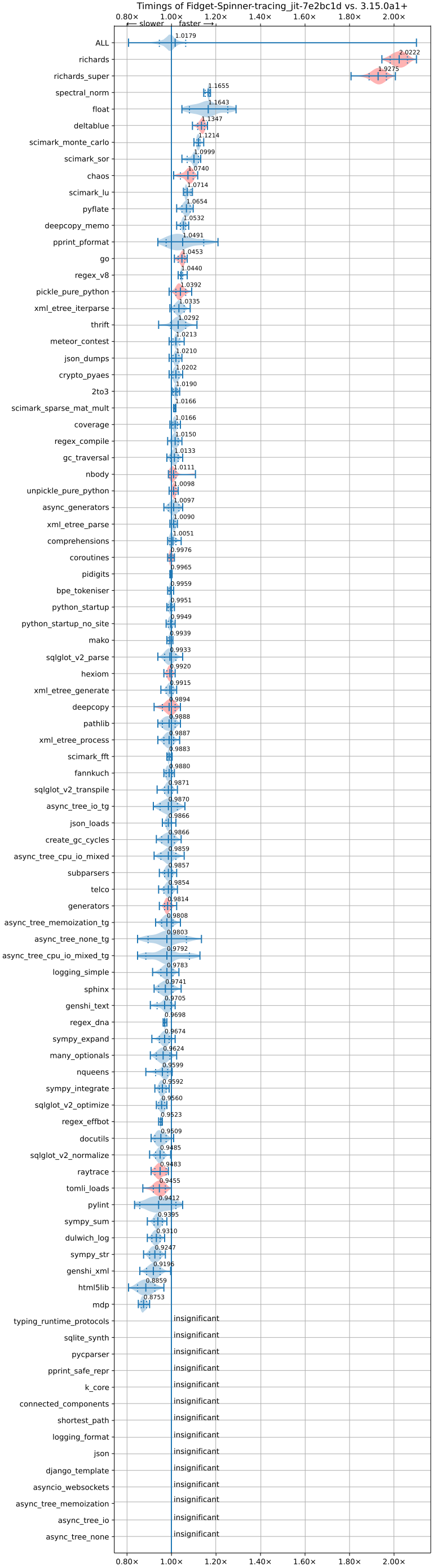
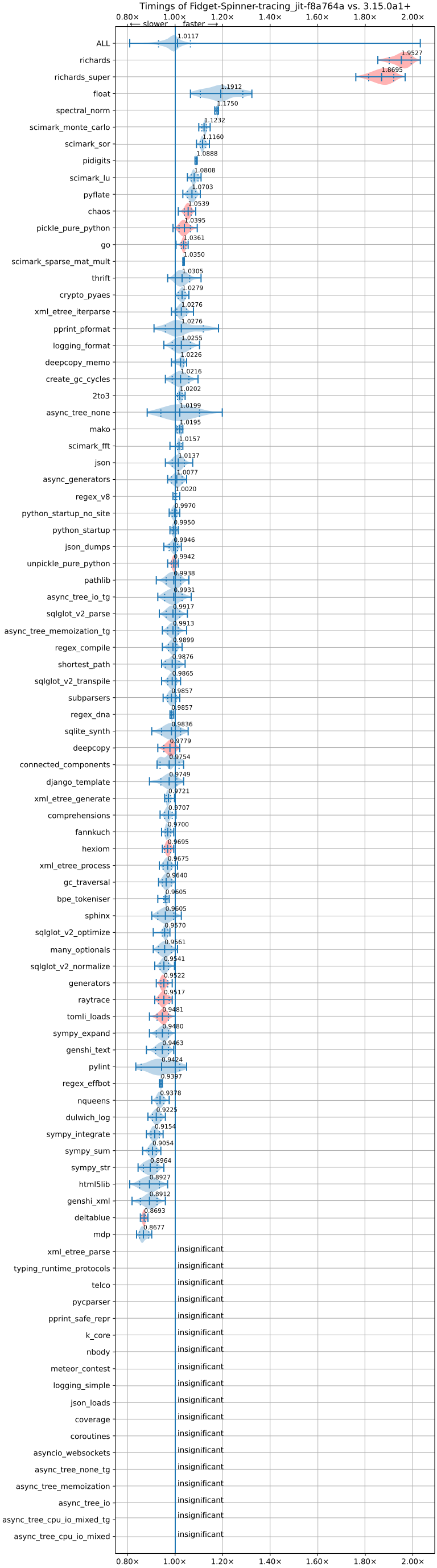
This PR changes the current JIT model from trace projection to trace recording. Benchmarking: better pyperformance (about 1.7% overall) geomean versus current https://raw.githubusercontent.com/facebookexperimental/free-threading-benchmarking/refs/heads/main/results/bm-20251108-3.15.0a1%2B-7e2bc1d-JIT/bm-20251108-vultr-x86_64-Fidget%252dSpinner-tracing_jit-3.15.0a1%2B-7e2bc1d-vs-base.svg, 100% faster Richards on the most improved benchmark versus the current JIT. Slowdown of about 10-15% on the worst benchmark versus the current JIT. **Note: the fastest version isn't the one merged, as it relies on fixing bugs in the specializing interpreter, which is left to another PR**. The speedup in the merged version is about 1.1%. https://raw.githubusercontent.com/facebookexperimental/free-threading-benchmarking/refs/heads/main/results/bm-20251112-3.15.0a1%2B-f8a764a-JIT/bm-20251112-vultr-x86_64-Fidget%252dSpinner-tracing_jit-3.15.0a1%2B-f8a764a-vs-base.svg

Stats: 50% more uops executed, 30% more traces entered the last time we ran them. It also suggests our trace lengths for a real trace recording JIT are too short, as a lot of trace too long aborts https://github.com/facebookexperimental/free-threading-benchmarking/blob/main/results/bm-20251023-3.15.0a1%2B-eb73378-CLANG%2CJIT/bm-20251023-vultr-x86_64-Fidget%252dSpinner-tracing_jit-3.15.0a1%2B-eb73378-pystats-vs-base.md .

This new JIT frontend is already able to record/execute significantly more instructions than the previous JIT frontend. In this PR, we are now able to record through custom dunders, simple object creation, generators, etc. None of these were done by the old JIT frontend. Some custom dunders uops were discovered to be broken as part of this work gh-140277

The optimizer stack space check is disabled, as it's no longer valid to deal with underflow.

Pros:
* Ignoring the generated tracer code as it's automatically created, this is only additional 1k lines of code. The maintenance burden is handled by the DSL and code generator.
* `optimizer.c` is now significantly simpler, as we don't have to do strange things to recover the bytecode from a trace.
* The new JIT frontend is able to handle a lot more control-flow than the old one.
* Tracing is very low overhead. We use the tail calling interpreter/computed goto interpreter to switch between tracing mode and non-tracing mode. I call this mechanism dual dispatch, as we have two dispatch tables dispatching to each other. Specialization is still enabled while tracing.
* Better handling of polymorphism. We leverage the specializing interpreter for this.

Cons:
* (For now) requires tail calling interpreter or computed gotos. This means no Windows JIT for now :(. Not to fret, tail calling is coming soon to Windows though https://github.com/python/cpython/pull/139962

Design:
* After each instruction, the `record_previous_inst` function/label is executed. This does as the name suggests.
* The tracing interpreter lowers bytecode to uops directly so that it can obtain "fresh" values at the point of lowering.
* The tracing version behaves nearly identical to the normal interpreter, in fact it even has specialization! This allows it to run without much of a slowdown when tracing. The actual cost of tracing is only a function call and writes to memory.
* The tracing interpreter uses the specializing interpreter's deopt to naturally form the side exit chains. This allows it to side exit chain effectively, without repeating much code. We force a re-specializing when tracing a deopt.
* The tracing interpreter can even handle goto errors/exceptions, but I chose to disable them for now as it's not tested.
* Because we do not share interpreter dispatch, there is should be no significant slowdown to the original specializing interpreter on tailcall and computed got with JIT disabled. With JIT enabled, there might be a slowdown in the form of the JIT trying to trace.
* Things that could have dynamic instruction pointer effects are guarded on. The guard deopts to a new instruction --- `_DYNAMIC_EXIT`.
Update `bytearray` to contain a `bytes` and provide a zero-copy path to
"extract" the `bytes`. This allows making several code paths more efficient.

This does not move any codepaths to make use of this new API. The documentation
changes include common code patterns which can be made more efficient with
this API.

---

When just changing `bytearray` to contain `bytes` I ran pyperformance on a
`--with-lto --enable-optimizations --with-static-libpython` build and don't see
any major speedups or slowdowns with this; all seems to be in the noise of
my machine (Generally changes under 5% or benchmarks that don't touch
bytes/bytearray).


Co-authored-by: Victor Stinner <vstinner@python.org>
Co-authored-by: Maurycy Pawłowski-Wieroński <5383+maurycy@users.noreply.github.com>
This makes information about the interpreter ABI more accessible.

Co-authored-by: Petr Viktorin <encukou@gmail.com>
Co-authored-by: Victor Stinner <vstinner@python.org>
Co-authored-by: Adam Turner <9087854+AA-Turner@users.noreply.github.com>
Default implementation of sys.unraisablehook() now uses traceback._print_exception_bltin() to print exceptions with colorized text.

Co-authored-by: Bénédikt Tran <10796600+picnixz@users.noreply.github.com>
Co-authored-by: Victor Stinner <vstinner@python.org>
PEP-734 has been accepted (for 3.14).

(FTR, I'm opposed to putting this under the concurrent package, but
doing so is the SC condition under which the module can land in 3.14.)
When sanity checking against gettotalrefcount(), we exclude the blocks for
immortalized strings since their references are not tracked/reported. This
now matches refleak.py's book-keeping using the same functions.
Run debugger scripts in their own namespaces

Previously scripts injected by `sys.remote_exec` were run with the
globals of the `__main__` module. Instead, run each injected script
with an empty set of globals. If someone really wants to use the
`__main__` module's namespace, they can always `import __main__`.
Make `warnings.catch_warnings()` use a context variable for holding
the warning filtering state if the `sys.flags.context_aware_warnings`
flag is set to true.  This makes using the context manager thread-safe in
multi-threaded programs.

Add the `sys.flags.thread_inherit_context` flag.  If true, starting a new
thread with `threading.Thread` will use a copy of the context
from the caller of `Thread.start()`.

Both these flags are set to true by default for the free-threaded build
and false for the default build.

Move the Python implementation of warnings.py into _py_warnings.py.

Make _contextvars a builtin module.

Co-authored-by: Kumar Aditya <kumaraditya@python.org>
Optimize `LOAD_FAST` opcodes into faster versions that load borrowed references onto the operand stack when we can prove that the lifetime of the local outlives the lifetime of the temporary that is loaded onto the stack.
The use of PySys_GetObject() and _PySys_GetAttr(), which return a borrowed
reference, has been replaced by using one of the following functions, which
return a strong reference and distinguish a missing attribute from an error:
_PySys_GetOptionalAttr(), _PySys_GetOptionalAttrString(),
_PySys_GetRequiredAttr(), and _PySys_GetRequiredAttrString().
* Implement C recursion protection with limit pointers for Linux, MacOS and Windows

* Remove calls to PyOS_CheckStack

* Add stack protection to parser

* Make tests more robust to low stacks

* Improve error messages for stack overflow
This reduces the size of _PyInterpreterFrame by 8 bytes on 64-bit
platforms using the free threading build due to alignment requirements.

This allows for slightly more recursive calls into the interpreter (from
C), but `test_call.test_super_deep` still crashes.
Each thread specializes a thread-local copy of the bytecode, created on the first RESUME, in free-threaded builds. All copies of the bytecode for a code object are stored in the co_tlbc array on the code object. Threads reserve a globally unique index identifying its copy of the bytecode in all co_tlbc arrays at thread creation and release the index at thread destruction. The first entry in every co_tlbc array always points to the "main" copy of the bytecode that is stored at the end of the code object. This ensures that no bytecode is copied for programs that do not use threads.

Thread-local bytecode can be disabled at runtime by providing either -X tlbc=0 or PYTHON_TLBC=0. Disabling thread-local bytecode also disables specialization.

Concurrent modifications to the bytecode made by the specializing interpreter and instrumentation use atomics, with specialization taking care not to overwrite an instruction that was instrumented concurrently.
On Windows, `long` is a signed 32-bit integer so it can't represent
`0xffff_ffff` without overflow. Windows exit codes are unsigned 32-bit
integers, so if a child process exits with `-1`, it will be represented
as `0xffff_ffff`.

Also fix a number of other possible cases where `_Py_HandleSystemExit`
could return with an exception set, leading to a `SystemError` (or
fatal error in debug builds) later on during shutdown.
The free-threaded build partially stores heap type reference counts in
distributed manner in per-thread arrays. This avoids reference count
contention when creating or destroying instances.

Co-authored-by: Ken Jin <kenjin@python.org>
The `PyStructSequence` destructor would crash if it was deallocated after
its type's dictionary was cleared by the GC, because it couldn't compute
the "real size" of the instance. This could occur with relatively
straightforward code in the free-threaded build or with a reference
cycle involving the type in the default build, due to differing orders
in which `tp_clear()` was called.

Account for the non-sequence fields in `tp_basicsize` and use that,
along with `Py_SIZE()`, to compute the "real" size of a
`PyStructSequence` in the dealloc function. This avoids the accesses to
the type's dictionary during dealloc, which were unsafe.
* Add an InternalDocs file describing how interning should work and how to use it.

* Add internal functions to *explicitly* request what kind of interning is done:
  - `_PyUnicode_InternMortal`
  - `_PyUnicode_InternImmortal`
  - `_PyUnicode_InternStatic`

* Switch uses of `PyUnicode_InternInPlace` to those.

* Disallow using `_Py_SetImmortal` on strings directly.
  You should use `_PyUnicode_InternImmortal` instead:
  - Strings should be interned before immortalization, otherwise you're possibly
    interning a immortalizing copy.
  - `_Py_SetImmortal` doesn't handle the `SSTATE_INTERNED_MORTAL` to
    `SSTATE_INTERNED_IMMORTAL` update, and those flags can't be changed in
    backports, as they are now part of public API and version-specific ABI.

* Add private `_only_immortal` argument for `sys.getunicodeinternedsize`, used in refleak test machinery.

* Make sure the statically allocated string singletons are unique. This means these sets are now disjoint:
  - `_Py_ID`
  - `_Py_STR` (including the empty string)
  - one-character latin-1 singletons

  Now, when you intern a singleton, that exact singleton will be interned.

* Add a `_Py_LATIN1_CHR` macro, use it instead of `_Py_ID`/`_Py_STR` for one-character latin-1 singletons everywhere (including Clinic).

* Intern `_Py_STR` singletons at startup.

* For free-threaded builds, intern `_Py_LATIN1_CHR` singletons at startup.

* Beef up the tests. Cover internal details (marked with `@cpython_only`).

* Add lots of assertions

Co-Authored-By: Eric Snow <ericsnowcurrently@gmail.com>
* Add docs for new APIs
* Add soft-deprecation notices
* Add What's New porting entries
* Update comments referencing `PyFrame_LocalsToFast()` to mention the proxy instead
* Other related cleanups found when looking for refs to the deprecated APIs
This PR adds the ability to enable the GIL if it was disabled at
interpreter startup, and modifies the multi-phase module initialization
path to enable the GIL when loading a module, unless that module's spec
includes a slot indicating it can run safely without the GIL.

PEP 703 called the constant for the slot `Py_mod_gil_not_used`; I went
with `Py_MOD_GIL_NOT_USED` for consistency with gh-104148.

A warning will be issued up to once per interpreter for the first
GIL-using module that is loaded. If `-v` is given, a shorter message
will be printed to stderr every time a GIL-using module is loaded
(including the first one that issues a warning).
The function returns `True` or `False` depending on whether the GIL is
currently enabled. In the default build, it always returns `True`
because the GIL is always enabled.