- Introduce a new field in the GC state to store the frame that initiated garbage collection.
- Update RemoteUnwinder to include options for including "<native>" and "<GC>" frames in the stack trace.
- Modify the sampling profiler to accept parameters for controlling the inclusion of native and GC frames.
- Enhance the stack collector to properly format and append these frames during profiling.
- Add tests to verify the correct behavior of the profiler with respect to native and GC frames, including options to exclude them.

Co-authored-by: Pablo Galindo Salgado <pablogsal@gmail.com>
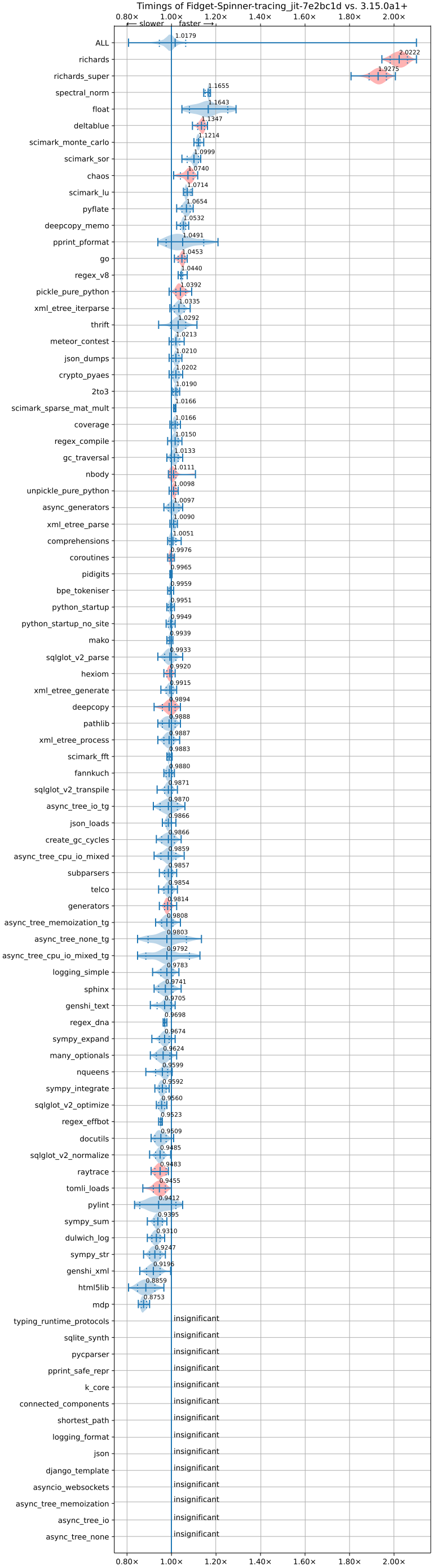
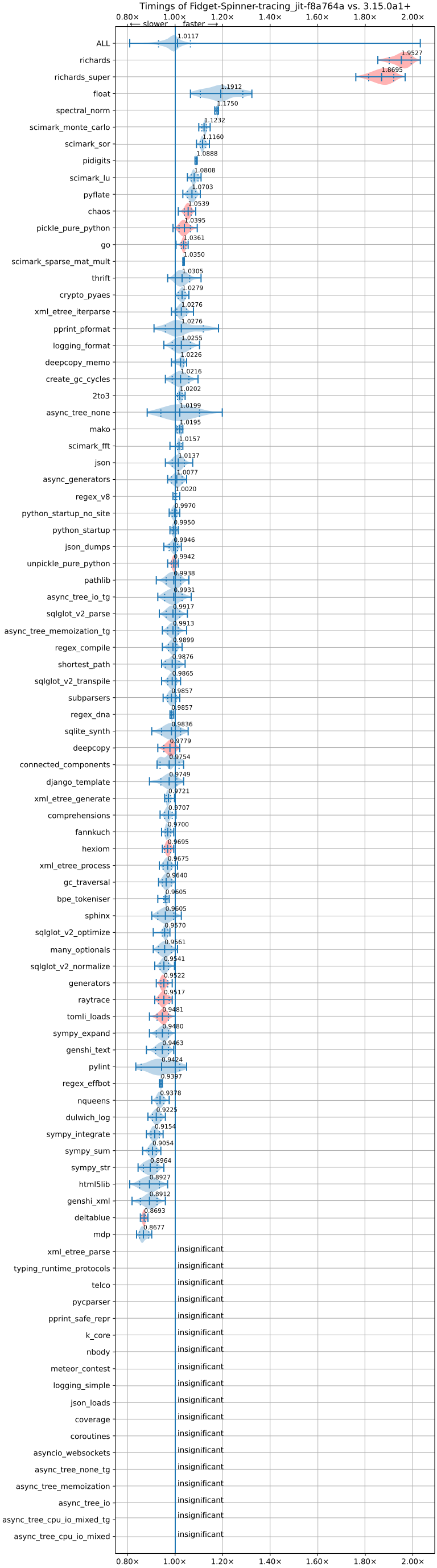
This PR changes the current JIT model from trace projection to trace recording. Benchmarking: better pyperformance (about 1.7% overall) geomean versus current https://raw.githubusercontent.com/facebookexperimental/free-threading-benchmarking/refs/heads/main/results/bm-20251108-3.15.0a1%2B-7e2bc1d-JIT/bm-20251108-vultr-x86_64-Fidget%252dSpinner-tracing_jit-3.15.0a1%2B-7e2bc1d-vs-base.svg, 100% faster Richards on the most improved benchmark versus the current JIT. Slowdown of about 10-15% on the worst benchmark versus the current JIT. **Note: the fastest version isn't the one merged, as it relies on fixing bugs in the specializing interpreter, which is left to another PR**. The speedup in the merged version is about 1.1%. https://raw.githubusercontent.com/facebookexperimental/free-threading-benchmarking/refs/heads/main/results/bm-20251112-3.15.0a1%2B-f8a764a-JIT/bm-20251112-vultr-x86_64-Fidget%252dSpinner-tracing_jit-3.15.0a1%2B-f8a764a-vs-base.svg

Stats: 50% more uops executed, 30% more traces entered the last time we ran them. It also suggests our trace lengths for a real trace recording JIT are too short, as a lot of trace too long aborts https://github.com/facebookexperimental/free-threading-benchmarking/blob/main/results/bm-20251023-3.15.0a1%2B-eb73378-CLANG%2CJIT/bm-20251023-vultr-x86_64-Fidget%252dSpinner-tracing_jit-3.15.0a1%2B-eb73378-pystats-vs-base.md .

This new JIT frontend is already able to record/execute significantly more instructions than the previous JIT frontend. In this PR, we are now able to record through custom dunders, simple object creation, generators, etc. None of these were done by the old JIT frontend. Some custom dunders uops were discovered to be broken as part of this work gh-140277

The optimizer stack space check is disabled, as it's no longer valid to deal with underflow.

Pros:
* Ignoring the generated tracer code as it's automatically created, this is only additional 1k lines of code. The maintenance burden is handled by the DSL and code generator.
* `optimizer.c` is now significantly simpler, as we don't have to do strange things to recover the bytecode from a trace.
* The new JIT frontend is able to handle a lot more control-flow than the old one.
* Tracing is very low overhead. We use the tail calling interpreter/computed goto interpreter to switch between tracing mode and non-tracing mode. I call this mechanism dual dispatch, as we have two dispatch tables dispatching to each other. Specialization is still enabled while tracing.
* Better handling of polymorphism. We leverage the specializing interpreter for this.

Cons:
* (For now) requires tail calling interpreter or computed gotos. This means no Windows JIT for now :(. Not to fret, tail calling is coming soon to Windows though https://github.com/python/cpython/pull/139962

Design:
* After each instruction, the `record_previous_inst` function/label is executed. This does as the name suggests.
* The tracing interpreter lowers bytecode to uops directly so that it can obtain "fresh" values at the point of lowering.
* The tracing version behaves nearly identical to the normal interpreter, in fact it even has specialization! This allows it to run without much of a slowdown when tracing. The actual cost of tracing is only a function call and writes to memory.
* The tracing interpreter uses the specializing interpreter's deopt to naturally form the side exit chains. This allows it to side exit chain effectively, without repeating much code. We force a re-specializing when tracing a deopt.
* The tracing interpreter can even handle goto errors/exceptions, but I chose to disable them for now as it's not tested.
* Because we do not share interpreter dispatch, there is should be no significant slowdown to the original specializing interpreter on tailcall and computed got with JIT disabled. With JIT enabled, there might be a slowdown in the form of the JIT trying to trace.
* Things that could have dynamic instruction pointer effects are guarded on. The guard deopts to a new instruction --- `_DYNAMIC_EXIT`.
Allow the --enable-pystats build option to be used with free-threading.  The
stats are now stored on a per-interpreter basis, rather than process global.
For free-threaded builds, the stats structure is allocated per-thread and
then periodically merged into the per-interpreter stats structure (on thread
exit or when the reporting function is called). Most of the pystats related
code has be moved into the file Python/pystats.c.
Fix memory leak in sub-interpreter creation caused by overwriting of the previously used `_malloced` field. Now the pointer is stored in the first word of the memory block to avoid it being overwritten accidentally.

Co-authored-by: Kumar Aditya <kumaraditya@python.org>
Fix memory leak in sub-interpreter creation caused by overwriting of the previously used `_malloced` field. Now the pointer is stored in the first word of the memory block to avoid it being overwritten accidentally.

Co-authored-by: Kumar Aditya <kumaraditya@python.org>
This partially reverts #137047, keeping the tests for GC collectability of the
original class that dataclass adds `__slots__` to.
The reference leaks solved there are instead solved by having the `__dict__` &
`__weakref__` descriptors not tied to (and referencing) their class.

Instead, they're shared between all classes that need them (within
an interpreter).
The `__objclass__` ol the descriptors is set to `object`, since these
descriptors work with *any* object. (The appropriate checks were already
made in the get/set code, so the `__objclass__` check was redundant.)

The repr of these descriptors (and any others whose `__objclass__` is `object`)
now doesn't mention the objclass.

This change required adjustment of introspection code that checks
`__objclass__` to determine an object's “own” (i.e. not inherited) `__dict__`.
Third-party code that does similar introspection of the internals will also
need adjusting.


Co-authored-by: Jelle Zijlstra <jelle.zijlstra@gmail.com>
There were a few thread-safety issues when profiling or tracing all
threads via PyEval_SetProfileAllThreads or PyEval_SetTraceAllThreads:

* The loop over thread states could crash if a thread exits concurrently
  (in both the free threading and default build)
* The modification of `c_profilefunc` and `c_tracefunc` wasn't
  thread-safe on the free threading build.
This commit fixes the following problems:

* The x86_64 trampolines are not preserving frame pointers
* The hardcoded offsets to the code segment from the FDE only worked properly for x64_64
* The CIE data was not following conventions of aarch64
* The eh_frame for aarch64 was not fully correct
* Replace _Py_ALIGN_AS(V) by _Py_ALIGNED_DEF(N, T)
This is now a common façade for the various `_Alignas` alternatives,
which behave in interesting ways -- see the source comment.
The new macro (and MSVC's `__declspec(align)`) should not be used
on a variable/member declaration that includes a struct declaraton.
A workaround is to separate the struct definition.
Do that for `PyASCIIObject.state`.
* Specify minimum PyGC_Head and PyObject alignment
As documented in InternalDocs/garbage_collector.md, the garbage collector
stores flags in the least significant two bits of the _gc_prev pointer
in struct PyGC_Head. Consequently, this pointer is only capable of storing
a location that's aligned to a 4-byte boundary.
Encode this requirement using _Py_ALIGNED_DEF.
This patch fixes a segfault in m68k, which was previously investigated
by Adrian Glaubitz here:
https://lists.debian.org/debian-68k/2024/11/msg00020.htmlhttps://bugs.debian.org/cgi-bin/bugreport.cgi?bug=1087600
Original patch (using the GCC-only Py_ALIGNED) by Finn Thain.
Co-authored-by: Finn Thain <fthain@linux-m68k.org>
Co-authored-by: Victor Stinner <vstinner@python.org>
Co-authored-by: John Paul Adrian Glaubitz <glaubitz@physik.fu-berlin.de>
In the free-threaded build, avoid data races caused by updating type
slots or type flags after the type was initially created.  For those
(typically rare) cases, use the stop-the-world mechanism.  Remove the
use of atomics when reading or writing type flags.
Completely refactor Modules/_remote_debugging_module.c with improved
code organization, replacing scattered reference counting and error
handling with centralized goto error paths. This cleanup improves
maintainability and reduces code duplication throughout the module while
preserving the same external API.

Implement memory page caching optimization in Python/remote_debug.h to
avoid repeated reads of the same memory regions during debugging
operations. The cache stores previously read memory pages and reuses
them for subsequent reads, significantly reducing system calls and
improving performance.

Add code object caching mechanism with a new code_object_generation
field in the interpreter state that tracks when code object caches need
invalidation. This allows efficient reuse of parsed code object metadata
and eliminates redundant processing of the same code objects across
debugging sessions.

Optimize memory operations by replacing multiple individual structure
copies with single bulk reads for the same data structures. This reduces
the number of memory operations and system calls required to gather
debugging information from the target process.

Update Makefile.pre.in to include Python/remote_debug.h in the headers
list, ensuring that changes to the remote debugging header force proper
recompilation of dependent modules and maintain build consistency across
the codebase.

Also, make the module compatible with the free threading build as an extra :)

Co-authored-by: Łukasz Langa <lukasz@langa.pl>
For the free-threaded build, check the process resident set size (RSS)
increase before triggering a full automatic garbage collection.  If the RSS
has not increased 10% since the last collection then it is deferred.
* Track the current executor, not the previous one, on the thread-state.

* Batch executors for deallocation to avoid having to constantly incref executors; this is an ad-hoc form of deferred reference counting.
In the free-threaded build, avoid data races caused by updating type slots
or type flags after the type was initially created.  For those (typically
rare) cases, use the stop-the-world mechanism.  Remove the use of atomics
when reading or writing type flags.  The use of atomics is not sufficient to
avoid races (since flags are sometimes read without a lock and without
atomics) and are no longer required.
Make `warnings.catch_warnings()` use a context variable for holding
the warning filtering state if the `sys.flags.context_aware_warnings`
flag is set to true.  This makes using the context manager thread-safe in
multi-threaded programs.

Add the `sys.flags.thread_inherit_context` flag.  If true, starting a new
thread with `threading.Thread` will use a copy of the context
from the caller of `Thread.start()`.

Both these flags are set to true by default for the free-threaded build
and false for the default build.

Move the Python implementation of warnings.py into _py_warnings.py.

Make _contextvars a builtin module.

Co-authored-by: Kumar Aditya <kumaraditya@python.org>
Move pycore_obmalloc.h include from pycore_interp_structs.h to
pycore_runtime_structs.h.

Add also comment explaining the purpose of each include in
pycore_interp_structs.h, pycore_runtime_structs.h and
pycore_structs.h.

Remove <stdbool.h> and <stddef.h> from pycore_structs.h.