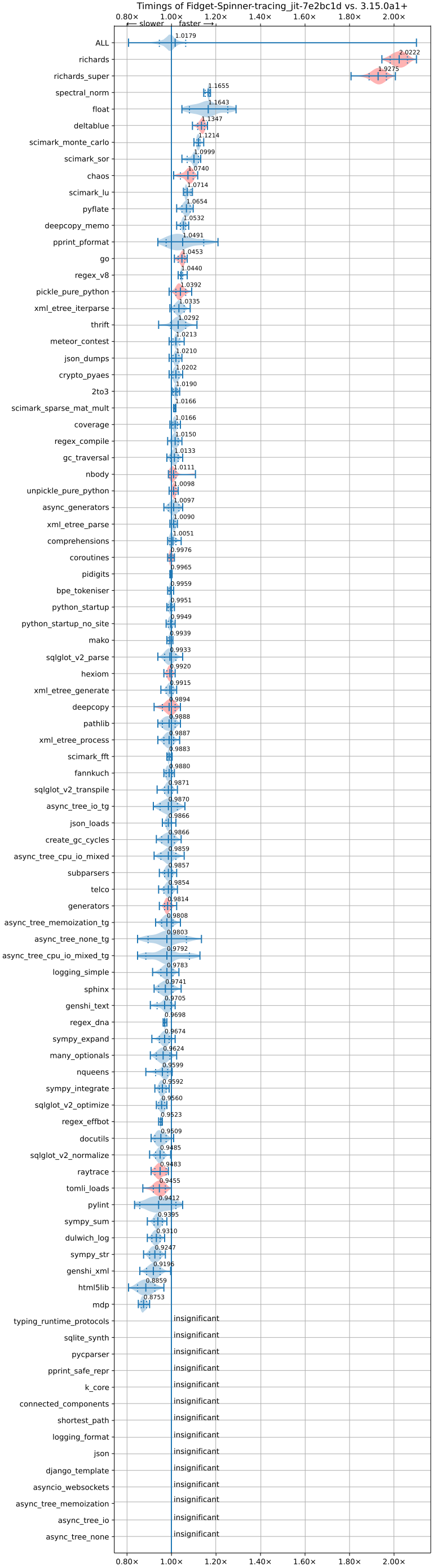
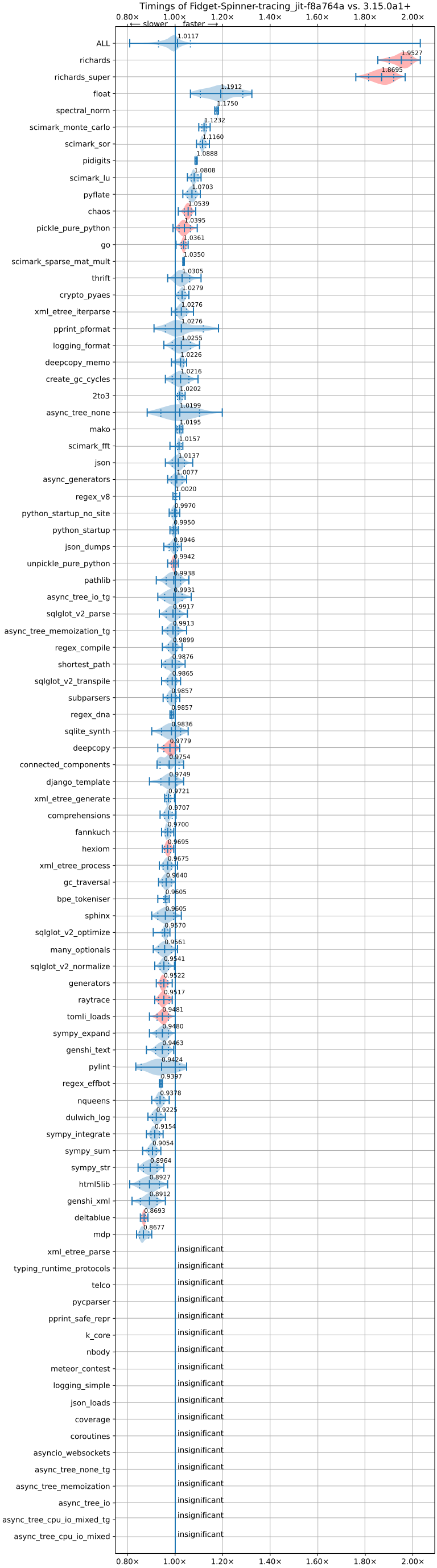
This PR changes the current JIT model from trace projection to trace recording. Benchmarking: better pyperformance (about 1.7% overall) geomean versus current https://raw.githubusercontent.com/facebookexperimental/free-threading-benchmarking/refs/heads/main/results/bm-20251108-3.15.0a1%2B-7e2bc1d-JIT/bm-20251108-vultr-x86_64-Fidget%252dSpinner-tracing_jit-3.15.0a1%2B-7e2bc1d-vs-base.svg, 100% faster Richards on the most improved benchmark versus the current JIT. Slowdown of about 10-15% on the worst benchmark versus the current JIT. **Note: the fastest version isn't the one merged, as it relies on fixing bugs in the specializing interpreter, which is left to another PR**. The speedup in the merged version is about 1.1%. https://raw.githubusercontent.com/facebookexperimental/free-threading-benchmarking/refs/heads/main/results/bm-20251112-3.15.0a1%2B-f8a764a-JIT/bm-20251112-vultr-x86_64-Fidget%252dSpinner-tracing_jit-3.15.0a1%2B-f8a764a-vs-base.svg

Stats: 50% more uops executed, 30% more traces entered the last time we ran them. It also suggests our trace lengths for a real trace recording JIT are too short, as a lot of trace too long aborts https://github.com/facebookexperimental/free-threading-benchmarking/blob/main/results/bm-20251023-3.15.0a1%2B-eb73378-CLANG%2CJIT/bm-20251023-vultr-x86_64-Fidget%252dSpinner-tracing_jit-3.15.0a1%2B-eb73378-pystats-vs-base.md .

This new JIT frontend is already able to record/execute significantly more instructions than the previous JIT frontend. In this PR, we are now able to record through custom dunders, simple object creation, generators, etc. None of these were done by the old JIT frontend. Some custom dunders uops were discovered to be broken as part of this work gh-140277

The optimizer stack space check is disabled, as it's no longer valid to deal with underflow.

Pros:
* Ignoring the generated tracer code as it's automatically created, this is only additional 1k lines of code. The maintenance burden is handled by the DSL and code generator.
* `optimizer.c` is now significantly simpler, as we don't have to do strange things to recover the bytecode from a trace.
* The new JIT frontend is able to handle a lot more control-flow than the old one.
* Tracing is very low overhead. We use the tail calling interpreter/computed goto interpreter to switch between tracing mode and non-tracing mode. I call this mechanism dual dispatch, as we have two dispatch tables dispatching to each other. Specialization is still enabled while tracing.
* Better handling of polymorphism. We leverage the specializing interpreter for this.

Cons:
* (For now) requires tail calling interpreter or computed gotos. This means no Windows JIT for now :(. Not to fret, tail calling is coming soon to Windows though https://github.com/python/cpython/pull/139962

Design:
* After each instruction, the `record_previous_inst` function/label is executed. This does as the name suggests.
* The tracing interpreter lowers bytecode to uops directly so that it can obtain "fresh" values at the point of lowering.
* The tracing version behaves nearly identical to the normal interpreter, in fact it even has specialization! This allows it to run without much of a slowdown when tracing. The actual cost of tracing is only a function call and writes to memory.
* The tracing interpreter uses the specializing interpreter's deopt to naturally form the side exit chains. This allows it to side exit chain effectively, without repeating much code. We force a re-specializing when tracing a deopt.
* The tracing interpreter can even handle goto errors/exceptions, but I chose to disable them for now as it's not tested.
* Because we do not share interpreter dispatch, there is should be no significant slowdown to the original specializing interpreter on tailcall and computed got with JIT disabled. With JIT enabled, there might be a slowdown in the form of the JIT trying to trace.
* Things that could have dynamic instruction pointer effects are guarded on. The guard deopts to a new instruction --- `_DYNAMIC_EXIT`.
Many functions related to compiling or parsing Python code, such as
compile(), ast.parse(), symtable.symtable(),
and importlib.abc.InspectLoader.source_to_code() now allow to pass
the module name used when filtering syntax warnings.
* Try to match the module name pattern with module names constructed
  starting from different parent directories of the filename.
  E.g., for "/path/to/package/module" try to match with
  "path.to.package.module", "to.package.module", "package.module" and
  "module".
* Ignore trailing "/__init__.py".
* Ignore trailing ".pyw" on Windows.
* Keep matching with the full filename (without optional ".py" extension)
  for compatibility.
* Only ignore the case of the ".py" extension on Windows.
Explicitly pass an `optimizer` parameter to the calls of `ast.parse/compile`, because if it is not provided, the interpreter will use its internal state, which can be modified using the `-O` or `-OO` flags.

Co-authored-by: Kirill Podoprigora <kirill.bast9@mail.ru>
* Implement C recursion protection with limit pointers for Linux, MacOS and Windows

* Remove calls to PyOS_CheckStack

* Add stack protection to parser

* Make tests more robust to low stacks

* Improve error messages for stack overflow
Revert "GH-91079: Implement C stack limits using addresses, not counters. (GH-130007)" for now

Unfortunatlely, the change broke some buildbots.

This reverts commit 2498c22fa0.
* Implement C recursion protection with limit pointers

* Remove calls to PyOS_CheckStack

* Add stack protection to parser

* Make tests more robust to low stacks

* Improve error messages for stack overflow
Previously, if the `ast.AST._fields` attribute was deleted, attempts to create a new `as`t node would crash due to the assumption that `_fields` always had a non-NULL value. Now it has been fixed by adding an extra check to ensure that `_fields` does not have a NULL value (this can happen when you manually remove `_fields` attribute).
* Remove `@suppress_immortalization` decorator
* Make suppression flag per-thread instead of per-interpreter
* Suppress immortalization in `eval()` to avoid refleaks in three tests
  (test_datetime.test_roundtrip, test_logging.test_config8_ok, and
   test_random.test_after_fork).
* frozenset() is constant, but not a singleton. When run multiple times,
  the test could fail due to constant interning.