 1ce6fd03b8
gofmt is pretty heavily CPU-bound, since parsing and formatting 1MiB of Go code takes much longer than reading that amount of bytes from disk. However, parsing and manipulating a large Go source file is very difficult to parallelize, so we continue to process each file in its own goroutine. A Go module may contain a large number of Go source files, so we need to bound the amount of work in flight. However, because the distribution of sizes for Go source files varies widely — from tiny doc.go files containing a single package comment all the way up to massive API wrappers generated by automated tools — the amount of time, work, and memory overhead needed to process each file also varies. To account for this variability, we limit the in-flight work by bytes of input rather than by number of files. That allows us to make progress on many small files while we wait for work on a handful of large files to complete. The gofmt tool has a well-defined output format on stdout, which was previously deterministic. We keep it deterministic by printing the results of each file in order, using a lazily-synchronized io.Writer (loosly inspired by Haskell's IO monad). After a file has been formatted in memory, we keep it in memory (again, limited by the corresponding number of input bytes) until the output for all previous files has been flushed. This adds a bit of latency compared to emitting the output in nondeterministic order, but a little extra latency seems worth the cost to preserve output stability. This change is based on Daniel Martí's work in CL 284139, but using a weighted semaphore and ephemeral goroutines instead of a worker pool and batches. Benchmark results are similar, and I find the concurrency in this approach a bit easier to reason about. In the batching-based approach, the batch size allows us to "look ahead" to find large files and start processing them early. To keep the CPUs saturated and prevent stragglers, we would need to tune the batch size to be about the same as the largest input files. If the batch size is set too high, a large batch of small files could turn into a straggler, but if the batch size is set too low, the largest files in the data set won't be started early enough and we'll end up with a large-file straggler. One possible alternative would be to sort by file size instead of batching: identify all of the files to be processed, sort from largest to smallest, and then process the largest files first so that the "tail" of processing covers the smallest files. However, that approach would still fail to saturate available CPU when disk latency is high, would require buffering an arbitrary amount of metadata in order to sort by size, and (perhaps most importantly!) would not allow the `gofmt` binary to preserve the same (deterministic) output order that it has today. In contrast, with a semaphore we can produce the same deterministic output as ever using only one tuning parameter: the memory footprint, expressed as a rough lower bound on the amount of RAM available per thread. While we're below the memory limit, we can run arbitrarily many disk operations arbitrarily far ahead, and process the results of those operations whenever they become avaliable. Then it's up to the kernel (not us) to schedule the disk operations for throughput and latency, and it's up to the runtime (not us) to schedule the goroutines so that they complete quickly. In practice, even a modest assumption of a few megabytes per thread seems to provide a nice speedup, and it should scale reasonably even to machines with vastly different ratios of CPU to disk. (In practice, I expect that most 'gofmt' invocations will work with files on at most one physical disk, so the CPU:disk ratio should vary more-or-less directly with the thread count, whereas the CPU:memory ratio is more-or-less independent of thread count.) name \ time/op baseline.txt 284139.txt simplified.txt GofmtGorootCmd 11.9s ± 2% 2.7s ± 3% 2.8s ± 5% name \ user-time/op baseline.txt 284139.txt simplified.txt GofmtGorootCmd 13.5s ± 2% 14.4s ± 1% 14.7s ± 1% name \ sys-time/op baseline.txt 284139.txt simplified.txt GofmtGorootCmd 465ms ± 8% 229ms ±28% 232ms ±31% name \ peak-RSS-bytes baseline.txt 284139.txt simplified.txt GofmtGorootCmd 77.7MB ± 4% 162.2MB ±10% 192.9MB ±15% For #43566 Change-Id: I4ba251eb4d188a3bd1901039086be57f0b341910 Reviewed-on: https://go-review.googlesource.com/c/go/+/317975 Trust: Bryan C. Mills <bcmills@google.com> Trust: Daniel Martí <mvdan@mvdan.cc> Run-TryBot: Bryan C. Mills <bcmills@google.com> TryBot-Result: Go Bot <gobot@golang.org> Reviewed-by: Daniel Martí <mvdan@mvdan.cc> |
||
|---|---|---|
| .github | ||
| api | ||
| doc | ||
| lib/time | ||
| misc | ||
| src | ||
| test | ||
| .gitattributes | ||
| .gitignore | ||
| AUTHORS | ||
| codereview.cfg | ||
| CONTRIBUTING.md | ||
| CONTRIBUTORS | ||
| LICENSE | ||
| PATENTS | ||
| README.md | ||
| SECURITY.md | ||
The Go Programming Language
Go is an open source programming language that makes it easy to build simple, reliable, and efficient software.
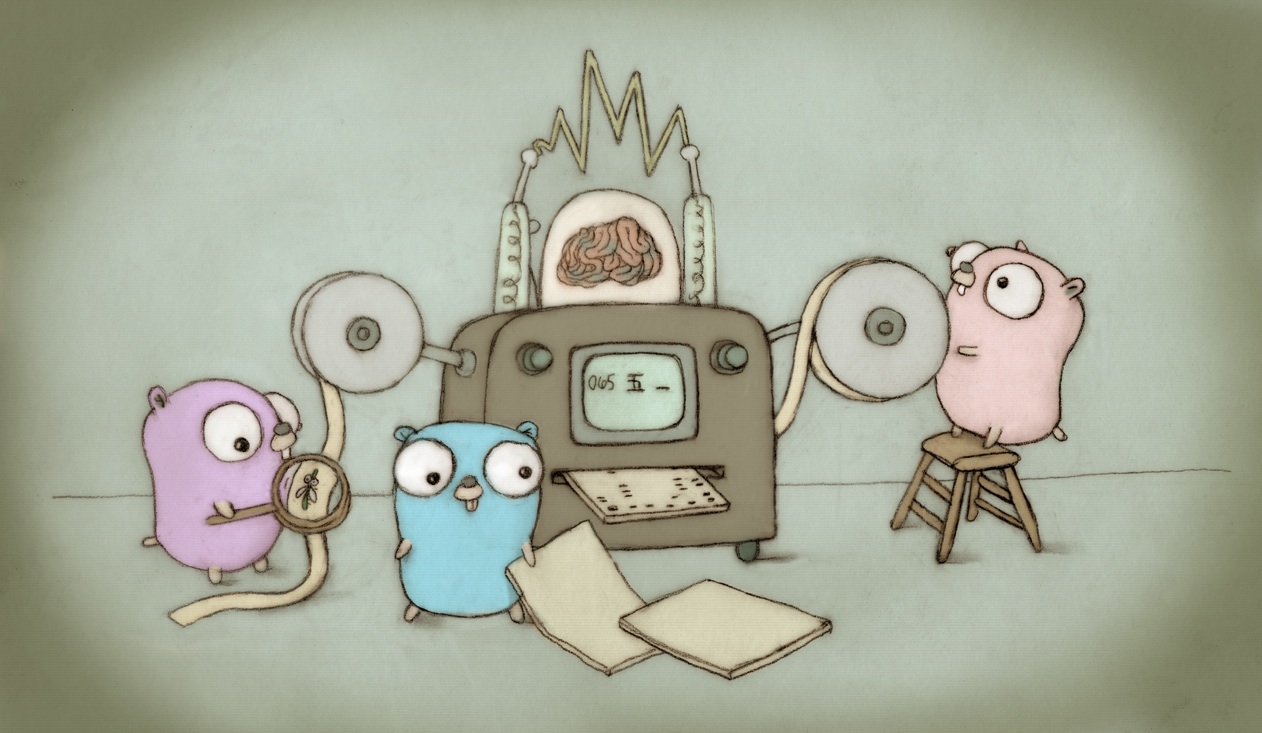 Gopher image by Renee French, licensed under Creative Commons 3.0 Attributions license.
Our canonical Git repository is located at https://go.googlesource.com/go. There is a mirror of the repository at https://github.com/golang/go.
Unless otherwise noted, the Go source files are distributed under the BSD-style license found in the LICENSE file.
Download and Install
Binary Distributions
Official binary distributions are available at https://golang.org/dl/.
After downloading a binary release, visit https://golang.org/doc/install for installation instructions.
Install From Source
If a binary distribution is not available for your combination of operating system and architecture, visit https://golang.org/doc/install/source for source installation instructions.
Contributing
Go is the work of thousands of contributors. We appreciate your help!
To contribute, please read the contribution guidelines at https://golang.org/doc/contribute.html.
Note that the Go project uses the issue tracker for bug reports and proposals only. See https://golang.org/wiki/Questions for a list of places to ask questions about the Go language.