Create and apply image filters using Godot's GLSL dialect.
| assets | ||
| build-template | ||
| dist | ||
| examples | ||
| scenes | ||
| shaderlib | ||
| src | ||
| .gitattributes | ||
| .gitignore | ||
| export_presets.cfg | ||
| LICENSE | ||
| project.godot | ||
| README.md | ||
| screenshot.png | ||


Fragmented
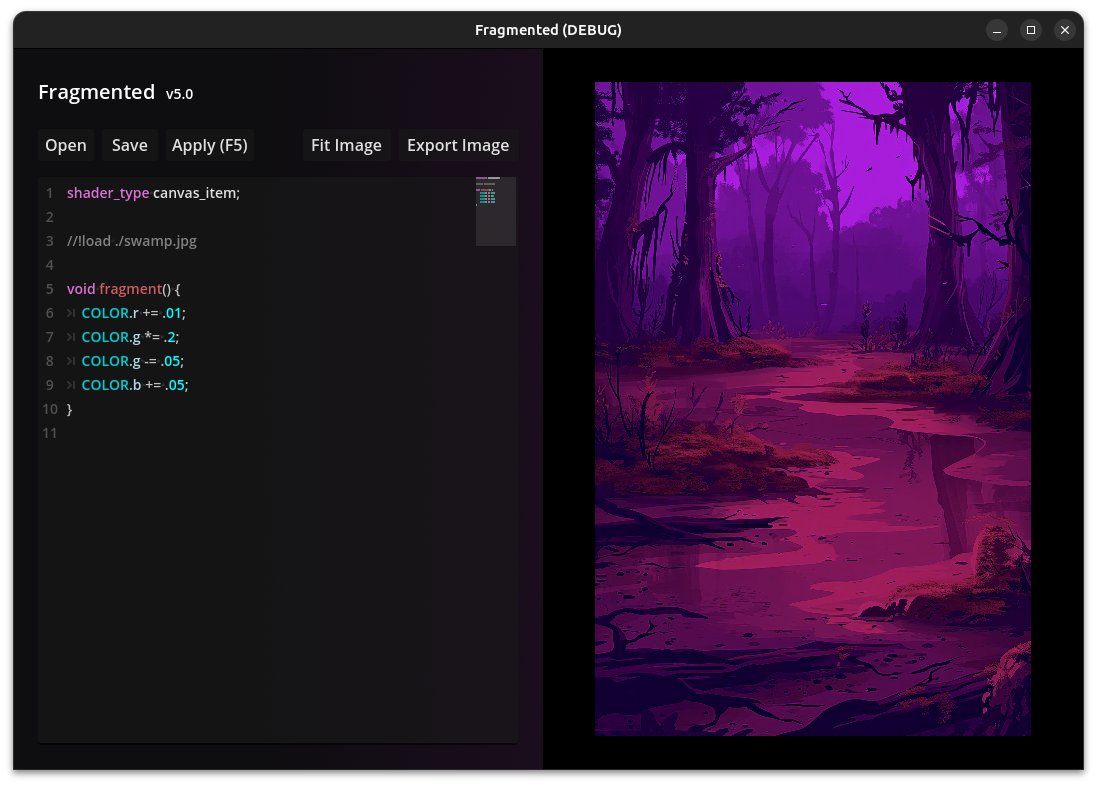
Create image filters by writing shaders.
Supported Platforms
- Linux
You can find the latest releases here.
Usage
The repo includes examples. You can use them as a starting-point to write your own filters.
Just load an image using //!load, edit the shader code and hit F5 to see the changes.
Load TEXTURE using the //!load directive
//!load <filepath>
The image file will be read and available as the TEXTURE variable.
Load additional images
//!load+ <name> <filepath>
uniform sampler2D <name>;
Have a look at the place_texture.gdshader example:
shader_type canvas_item;

#include "res://shaderlib/transform.gdshaderinc"

//!load ./swamp.jpg
//!load+ img2 ./grass.png

uniform sampler2D img2: repeat_disable, filter_nearest;

void fragment() {
	vec4 grass = place_texture(img2, UV, TEXTURE_PIXEL_SIZE, vec2(0, .47), vec2(1));
	grass.rgb += (vec3(0.03, 0.07, 0.11) - ((UV.y - .8) * 0.15)); // color correction
	COLOR.rgb = mix(COLOR.rgb, grass.rgb, grass.a);
}
Shaderlib
This repo comes with a (still small) shader library including pre-written functions and more.
Have a look at the shaderlib folder.
Here is an example on how to use it (the hsv.gdshader example):
shader_type canvas_item;

#include "res://shaderlib/hsv.gdshaderinc"

//!load ./swamp.jpg

void fragment() {
	COLOR = hsv_offset(COLOR, 0.32, 0.2, 0.0);
}