Co-authored-by: Ken Jin <28750310+Fidget-Spinner@users.noreply.github.com>
Co-authored-by: Brandt Bucher <brandt@python.org>
Co-authored-by: Hugo van Kemenade <1324225+hugovk@users.noreply.github.com>
The use of memmove and _Py_memory_repeat were not thread-safe in the
free threading build in some cases. In theory, memmove and
_Py_memory_repeat can copy byte-by-byte instead of pointer-by-pointer,
so concurrent readers could see uninitialized data or tearing.

Additionally, we should be using "release" (or stronger) ordering to be
compliant with the C11 memory model when copying objects within a list.
This makes generator frame state transitions atomic in the free
threading build, which avoids segfaults when trying to execute
a generator from multiple threads concurrently.

There are still a few operations that aren't thread-safe and may crash
if performed concurrently on the same generator/coroutine:

 * Accessing gi_yieldfrom/cr_await/ag_await
 * Accessing gi_frame/cr_frame/ag_frame
 * Async generator operations
Now that we specialize range iteration in the interpreter for the common
case where the iterator has only one reference, there's not a
significant performance cost to making the iteration thread-safe.
This combines most _PyStackRef functions and macros between the free
threaded and default builds.

- Remove Py_TAG_DEFERRED (same as Py_TAG_REFCNT)
- Remove PyStackRef_IsDeferred (same as !PyStackRef_RefcountOnObject)
When a `str` is encoded in `bytearray.__init__` the encoder tends to
create a new unique bytes object. Rather than allocate new memory and
copy the bytes use the already created bytes object as bytearray
backing. The bigger the `str` the bigger the saving.

Mean +- std dev: [main_encoding] 497 us +- 9 us -> [encoding] 14.2 us +- 0.3 us: 34.97x faster

```python
import pyperf

runner = pyperf.Runner()

runner.timeit(
    name="encode",
    setup="a = 'a' * 1_000_000",
    stmt="bytearray(a, encoding='utf8')")
```
We need to use release/acquire ordering for the 'mask' member of the set
structure. Without this, `set_lookkey_threadsafe()` could be looking at
the old value of `table` but the new value of `mask`.
This roughly follows what was done for dictobject to make a lock-free
lookup operation. With this change, the set contains operation scales much
better when used from multiple-threads. The frozenset contains performance
seems unchanged (as already lock-free).

Summary of changes:

* refactor set_lookkey() into set_do_lookup() which now takes a function
  pointer that does the entry comparison. This is similar to dictobject and
  do_lookup(). In an optimized build, the comparison function is inlined and
  there should be no performance cost to this.

* change set_do_lookup() to return a status separately from the entry value

* add set_compare_frozenset() and use if the object is a frozenset. For the
  free-threaded build, this avoids some overhead (locking, atomic operations,
  incref/decref on key)

* use FT_ATOMIC_* macros as needed for atomic loads and stores

* use a deferred free on the set table array, if shared (only on free-threaded
  build, normal build always does an immediate free)

* for free-threaded build, use explicit for loop to zero the table, rather than memcpy()

* when mutating the set, assign so->table to NULL while the change is a
  happening. Assign the real table array after the change is done.
There are places we use "relaxed" loads where C11 requires "consume" or
stronger. Unfortunately, compilers don't really implement "consume" so
fake it for our use in a way that avoids upsetting TSan.
This fixes a regression introduced in gh-140558. The interpreter would
crash if we inserted a non `str` key into a split table that matches an
existing key.
* Make Py_{SIZE,IS_TYPE,SET_SIZE} regular functions in stable ABI

Group them together with Py_TYPE & Py_SET_TYPE to cut down
on repetitive preprocessor macros.
Format repetitive definitions in object.c more concisely.

Py_SET_TYPE is still left out of the Limited API.
The dataclasses `__init__` function is generated dynamically by a call to `exec()` and so doesn't have deferred reference counting enabled. Enable deferred reference counting on functions when assigned as an attribute to type objects to avoid reference count contention when creating dataclass instances.
* Promote _PyObject_Dump() as a public function.
* Keep _PyObject_Dump() alias to PyUnstable_Object_Dump()
  for backward compatibility.
* Replace _PyObject_Dump() with PyUnstable_Object_Dump().

Co-authored-by: Peter Bierma <zintensitydev@gmail.com>
Co-authored-by: Kumar Aditya <kumaraditya@python.org>
Co-authored-by: Petr Viktorin <encukou@gmail.com>
Replace code that directly accesses PyASCIIObject.hash with
PyUnstable_Unicode_GET_CACHED_HASH().

Remove redundant "assert(PyUnicode_Check(op))" from
PyUnstable_Unicode_GET_CACHED_HASH(), _PyASCIIObject_CAST() already
implements the check.
This needs a single bit, but was stored as a void* in the module
struct. This didn't matter due to packing, but now that there's
another bool in the struct, we can save a bit of memory by
making md_gil a bool.

Variables that changed type are renamed, to detect conflicts.
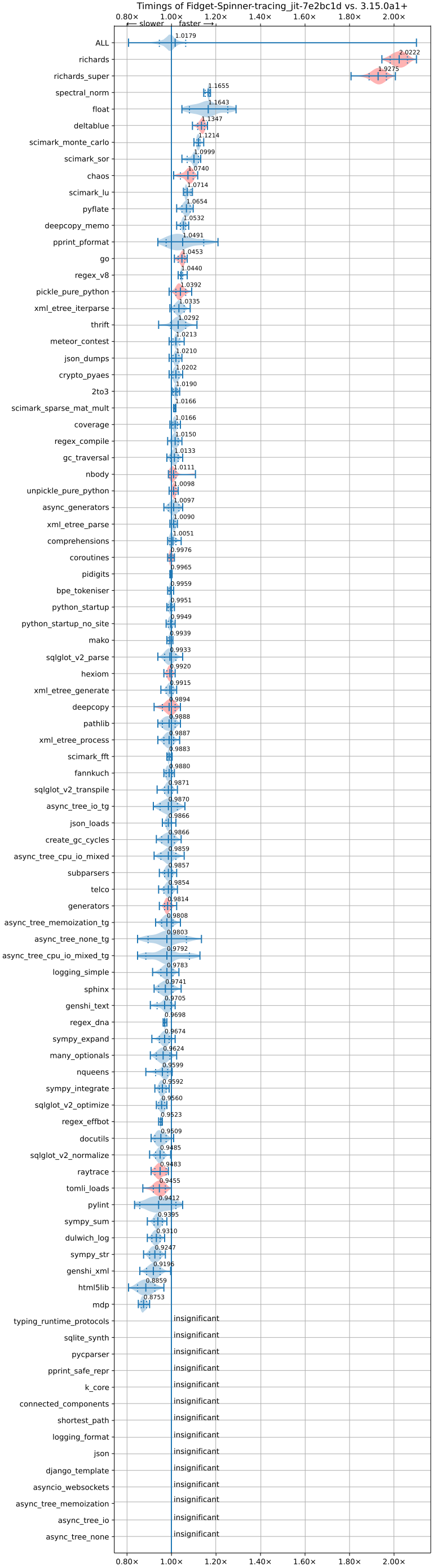
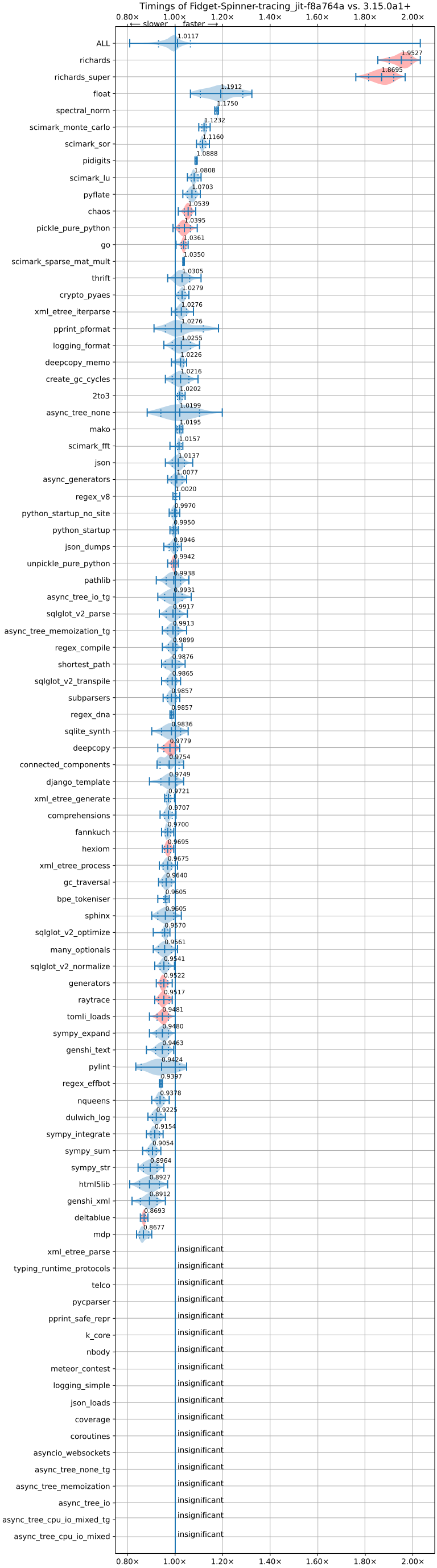
This PR changes the current JIT model from trace projection to trace recording. Benchmarking: better pyperformance (about 1.7% overall) geomean versus current https://raw.githubusercontent.com/facebookexperimental/free-threading-benchmarking/refs/heads/main/results/bm-20251108-3.15.0a1%2B-7e2bc1d-JIT/bm-20251108-vultr-x86_64-Fidget%252dSpinner-tracing_jit-3.15.0a1%2B-7e2bc1d-vs-base.svg, 100% faster Richards on the most improved benchmark versus the current JIT. Slowdown of about 10-15% on the worst benchmark versus the current JIT. **Note: the fastest version isn't the one merged, as it relies on fixing bugs in the specializing interpreter, which is left to another PR**. The speedup in the merged version is about 1.1%. https://raw.githubusercontent.com/facebookexperimental/free-threading-benchmarking/refs/heads/main/results/bm-20251112-3.15.0a1%2B-f8a764a-JIT/bm-20251112-vultr-x86_64-Fidget%252dSpinner-tracing_jit-3.15.0a1%2B-f8a764a-vs-base.svg

Stats: 50% more uops executed, 30% more traces entered the last time we ran them. It also suggests our trace lengths for a real trace recording JIT are too short, as a lot of trace too long aborts https://github.com/facebookexperimental/free-threading-benchmarking/blob/main/results/bm-20251023-3.15.0a1%2B-eb73378-CLANG%2CJIT/bm-20251023-vultr-x86_64-Fidget%252dSpinner-tracing_jit-3.15.0a1%2B-eb73378-pystats-vs-base.md .

This new JIT frontend is already able to record/execute significantly more instructions than the previous JIT frontend. In this PR, we are now able to record through custom dunders, simple object creation, generators, etc. None of these were done by the old JIT frontend. Some custom dunders uops were discovered to be broken as part of this work gh-140277

The optimizer stack space check is disabled, as it's no longer valid to deal with underflow.

Pros:
* Ignoring the generated tracer code as it's automatically created, this is only additional 1k lines of code. The maintenance burden is handled by the DSL and code generator.
* `optimizer.c` is now significantly simpler, as we don't have to do strange things to recover the bytecode from a trace.
* The new JIT frontend is able to handle a lot more control-flow than the old one.
* Tracing is very low overhead. We use the tail calling interpreter/computed goto interpreter to switch between tracing mode and non-tracing mode. I call this mechanism dual dispatch, as we have two dispatch tables dispatching to each other. Specialization is still enabled while tracing.
* Better handling of polymorphism. We leverage the specializing interpreter for this.

Cons:
* (For now) requires tail calling interpreter or computed gotos. This means no Windows JIT for now :(. Not to fret, tail calling is coming soon to Windows though https://github.com/python/cpython/pull/139962

Design:
* After each instruction, the `record_previous_inst` function/label is executed. This does as the name suggests.
* The tracing interpreter lowers bytecode to uops directly so that it can obtain "fresh" values at the point of lowering.
* The tracing version behaves nearly identical to the normal interpreter, in fact it even has specialization! This allows it to run without much of a slowdown when tracing. The actual cost of tracing is only a function call and writes to memory.
* The tracing interpreter uses the specializing interpreter's deopt to naturally form the side exit chains. This allows it to side exit chain effectively, without repeating much code. We force a re-specializing when tracing a deopt.
* The tracing interpreter can even handle goto errors/exceptions, but I chose to disable them for now as it's not tested.
* Because we do not share interpreter dispatch, there is should be no significant slowdown to the original specializing interpreter on tailcall and computed got with JIT disabled. With JIT enabled, there might be a slowdown in the form of the JIT trying to trace.
* Things that could have dynamic instruction pointer effects are guarded on. The guard deopts to a new instruction --- `_DYNAMIC_EXIT`.
Update `bytearray` to contain a `bytes` and provide a zero-copy path to
"extract" the `bytes`. This allows making several code paths more efficient.

This does not move any codepaths to make use of this new API. The documentation
changes include common code patterns which can be made more efficient with
this API.

---

When just changing `bytearray` to contain `bytes` I ran pyperformance on a
`--with-lto --enable-optimizations --with-static-libpython` build and don't see
any major speedups or slowdowns with this; all seems to be in the noise of
my machine (Generally changes under 5% or benchmarks that don't touch
bytes/bytearray).


Co-authored-by: Victor Stinner <vstinner@python.org>
Co-authored-by: Maurycy Pawłowski-Wieroński <5383+maurycy@users.noreply.github.com>
faulthandler now detects if a frame or a code object is invalid or
freed.

Add helper functions:

* _PyCode_SafeAddr2Line()
* _PyFrame_SafeGetCode()
* _PyFrame_SafeGetLasti()

_PyMem_IsPtrFreed() now detects pointers in [-0xff, 0xff] range
as freed.