| .circleci | ||
| ast | ||
| cmd/ycat | ||
| docs | ||
| internal/errors | ||
| lexer | ||
| parser | ||
| printer | ||
| scanner | ||
| testdata | ||
| token | ||
| .codecov.yml | ||
| decode.go | ||
| decode_test.go | ||
| encode.go | ||
| encode_test.go | ||
| go.mod | ||
| go.sum | ||
| LICENSE | ||
| Makefile | ||
| option.go | ||
| README.md | ||
| struct.go | ||
| validate.go | ||
| validate_test.go | ||
| yaml.go | ||
| yaml_test.go | ||

YAML support for the Go language




Why a new library?
As of this writing, there already exists a defacto standard library for YAML processing Go: https://github.com/go-yaml/yaml. However we feel that some features are lacking, namely:
- Pretty format for error notifacations
- Directly manipulate the YAML abstract syntax tree
- Support
AnchorandAliaswhen marshaling - Allow referencing elements declared in another file via anchors
Status
- This library should be considered alpha grade. API may still change.
Features ( Goals )
- Pretty format for error notifacations
- Support
ScannerorLexerorParseras public API - Support
AnchorandAliasto Marshaler - Allow referencing elements declared in another file via anchors
Synopsis
1. Simple Encode/Decode
Support compatible interface to go-yaml/yaml by using reflect
var v struct {
	A int
	B string
}
v.A = 1
v.B = "hello"
bytes, err := yaml.Marshal(v)
if err != nil {
	...
}
fmt.Println(string(bytes)) // "a: 1\nb: hello\n"
	yml := `
%YAML 1.2
---
a: 1
b: c
`
var v struct {
	A int
	B string
}
if err := yaml.Unmarshal([]byte(yml), &v); err != nil {
	...
}
For custom marshal/unmarshaling, implement one of Bytes or Interface Marshaler/Unmarshaler. The difference is that while BytesMarshaler/BytesUnmarshaler behave like encoding.json, InterfaceMarshaler/InterfaceUnmarshaler behave like gopkg.in/yaml.v2.
Semantically both are the same, but they differ in performance. Because indentation matter in YAML, you cannot simply accept a valid YAML fragment from a Marshaler, and expect it to work when it is attached to the parent container's serialized form. Therefore when we receive use the BytesMarshaler, which returns []byte, we must decode it once to figure out how to make it work in the given context. If you use the InterfaceMarshaler, we can skip the decoding.
If you are repeatedly marshaling complex objects, the latter is always better performance wise. But if you are, for example, just providing a choice between a config file format that is read only once, the former is probably easier to code.
2. Reference elements in declared in another file
testdata directory includes anchor.yml file
├── testdata
   └── anchor.yml
And anchor.yml is defined the following.
a: &a
  b: 1
  c: hello
Then, if yaml.ReferenceDirs("testdata") option passed to yaml.Decoder,
Decoder try to find anchor definition from YAML files the under testdata directory.
buf := bytes.NewBufferString("a: *a\n")
dec := yaml.NewDecoder(buf, yaml.ReferenceDirs("testdata"))
var v struct {
	A struct {
		B int
		C string
	}
}
if err := dec.Decode(&v); err != nil {
	...
}
fmt.Printf("%+v\n", v) // {A:{B:1 C:hello}}
3. Encode with Anchor and Alias
3.1. Explicitly declaration Anchor name and Alias name
If you want to use anchor or alias, you can define it as a struct tag.
type T struct {
  A int
  B string
}
var v struct {
  C *T `yaml:"c,anchor=x"`
  D *T `yaml:"d,alias=x"`
}
v.C = &T{A: 1, B: "hello"}
v.D = v.C
bytes, err := yaml.Marshal(v)
if err != nil {
  panic(err)
}
fmt.Println(string(bytes))
/*
c: &x
  a: 1
  b: hello
d: *x
*/
3.2. Implicitly declared Anchor and Alias names
If you do not explicitly declare the anchor name, the default behavior is to
use the equivalent of strings.ToLower($FieldName) as the name of the anchor.
If you do not explicitly declare the alias name AND the value is a pointer to another element, we look up the anchor name by finding out which anchor field the value is assigned to by looking up its pointer address.
type T struct {
	I int
	S string
}
var v struct {
	A *T `yaml:"a,anchor"`
	B *T `yaml:"b,anchor"`
	C *T `yaml:"c,alias"`
	D *T `yaml:"d,alias"`
}
v.A = &T{I: 1, S: "hello"}
v.B = &T{I: 2, S: "world"}
v.C = v.A // C has same pointer address to A
v.D = v.B // D has same pointer address to B
bytes, err := yaml.Marshal(v)
if err != nil {
	...
}
fmt.Println(string(bytes))
/*
a: &a
  i: 1
  s: hello
b: &b
  i: 2
  s: world
c: *a
d: *b
*/
3.3 MergeKey and Alias
Merge key and alias ( <<: *alias ) can be used by embedding a structure with the inline,alias tag .
type Person struct {
	*Person `yaml:",omitempty,inline,alias"` // embed Person type for default value
	Name    string `yaml:",omitempty"`
	Age     int    `yaml:",omitempty"`
}
defaultPerson := &Person{
	Name: "John Smith",
	Age:  20,
}
people := []*Person{
	{
		Person: defaultPerson, // assign default value
		Name:   "Ken",         // override Name property
		Age:    10,            // override Age property
	},
	{
		Person: defaultPerson, // assign default value only
	},
}
var doc struct {
	Default *Person   `yaml:"default,anchor"`
	People  []*Person `yaml:"people"`
}
doc.Default = defaultPerson
doc.People = people
bytes, err := yaml.Marshal(doc)
if err != nil {
	...
}
fmt.Println(string(bytes))
/*
default: &default
  name: John Smith
  age: 20
people:
- <<: *default
  name: Ken
  age: 10
- <<: *default
*/
4. Pretty Formatted Errors
Error values produced during parsing has two extra features over regular error values.
First by default they contain extra information on the location of the error from the source YAML document, to make it easier finding the error location.
Second, the error messages can optionally be colorized.
If you would like to control exactly how the output looks like, consider
using yaml.FormatError, which accepts two boolean values to
control turning on/off these features

Installation
$ go get -u github.com/goccy/go-yaml
Tools
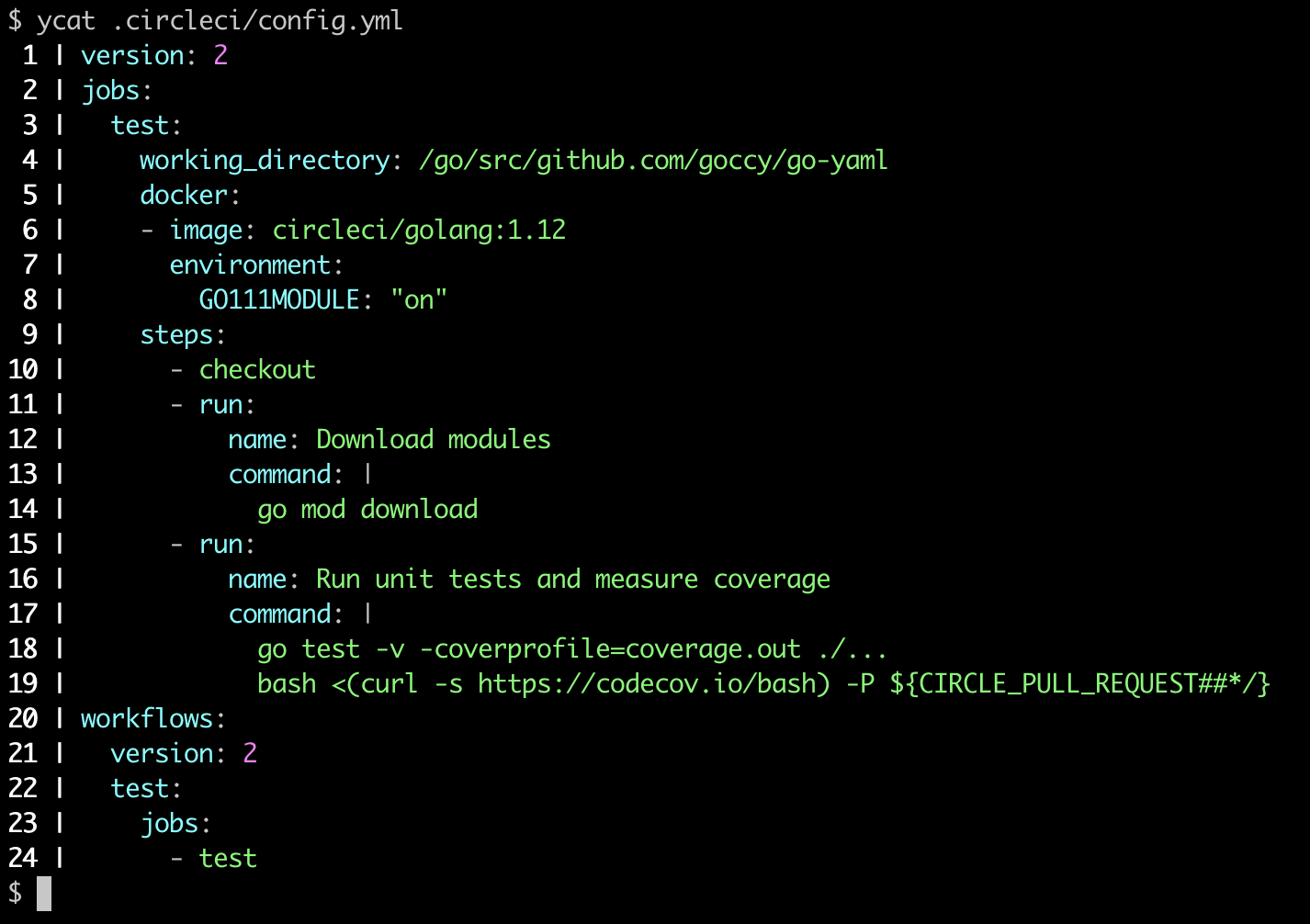
ycat
print yaml file with color
Install
$ go get -u github.com/goccy/go-yaml/cmd/ycat
License
MIT